Welcome!

Welcome to austinagrodolce … My family and I garden with more intention and enthusiasm than allocated budget or overall design plan. It shows. Wildlife populations don't seem to notice our lack of cohesive design, they just like the native plants here. It seems by growing local we've thrown out a welcome mat. Occasionally, we're surprised at who (and what) shows up.


Showing posts with label Ants. Show all posts

Wednesday, April 1, 2015

Things are getting all Wild up in here

Welcome to Wildlife Wednesday, a monthly look at who and what we are seeing around our outdoor spaces this first Wednesday in April, 2015.

I am aware I've posted a whole lot of anole shots here already, but that is because they are a predominant year round companion species in my garden. Now that temperatures are warm (and getting warmer), anoles are everywhere.  In a short ten minute trek around the back beds to check on buds and look for first blooms, I spotted four.  I did not have to guess as to whether they are males because as you can see, they were all busy demonstrating just that fact.
Maybe The Bachlelor reality television show should rethink that rose business? The guys could just display...oh....wait....never mind.
Because the flowers are back in numbers now, so are the pollinators. Swaths of bluebonnets are drawing in loads of European honeybees.
Other bees native to our area, with their more solitary life styles, are busy checking out the housing situation. Shown below is a female Xylocopa micans, a carpenter bee.  They like to recycle holes in and around wooden structures. This one carefully inspected the wind chimes from every angle before deciding it wasn't quite time to call the moving van company.

To follow is another native bee, what I believe is a Dialictus zephrum, or sweat bee.  It is that teeny tiny metallic blur to the upper right of the frame.  There are over 1,000 species found in North America so if you haven't seen these yet, it is probably only a matter of time.
Another favorite in the "can't quite catch it still long enough for a good photo" category?  An eight-spotted forester moth is up next, demonstrating its preference for Virginia creeper as a host plant.

You might look at this and say "no Texas Deb, I now realize you aren't kidding - you really ARE bad at the identification process, because that is sure enough Asian jasmine" to which I'd reply "Look again to the lower left.  There are strands of Virginia creeper growing right under the jasmine, ready to climb up on top when the time is right.".  (you have these conversations with people in your head too, right?Right??)  I digress.  Eight Spotted Forester Moth!  On a leaf!
Here's a better example.  Alypia octomaculata.  Ovipositing on (and around) preferential host plant Virginia Creeper.
Next up is a Grey Hairstreak butterfly, Strymon melinus.  Reportedly males spend sunny afternoons perched on small shrubs to attract females.  This one was busy nectaring so perhaps he has already met and mated?  Or perhaps this is a female, ignoring the males for a bit and helping herself to the sugar buffet.
American Painted Lady butterflies have been visiting.  It may be accidental, but those oranges against the purple prairie verbena are a striking color combination.
I think they are gorgeous from any angle.

Next to last (but not least!) a Tropical Checkered Skipper butterfly, (Pyrgus oileus) who helped me realize I did not get all the bristly mallow seedlings out of the paths.  Or the beds. Watching this tiny wonder, who very methodically landed on mallow and mallow alone, demonstrated there are small mallow seedlings remaining in several spots.  

As this seemed to be a female laying eggs, I am going to leave the mallow plants in place until I can be assured I'm not pulling out a butterfly nursery posing as a weed.  I'll police the seed heads but otherwise the tropical skipper attention has granted this plant a temporary pass.

I adore those tiny orange blossoms. So much so I gave this mallow a trial run last year as potential ground cover under a bird feeder. It grew alarmingly well throughout the winter months while everything else was dormant so I decided it best to pull it "all" out.  I am often careless when it comes to ignoring the "weed" designation, but if watching butterflies is my penalty for lackadaisical removal?  
I'll take that penalty any day, all day long.

And now for a bit of slightly less adorable business.  There have been recent reports of a new invasive ant species in our area, typically identified by a characteristic giant mounding of the opening to its colony.

Tentatively identified as a newly noted species of Dorymyrmex, at least one occurrence of the soil nesting ants with their characteristic volcano shaped entrances has been spotted in this lawn close to Lady Bird Lake.  If you see this or any other large ant nesting area, proceed with caution and keep your distance.
Luna, 2006, Ursula von Rydingsvard, artist.  The Contemporary Austin – Betty and Edward Marcus Sculpture Park at Laguna Gloria. 
Just fooling.  Have a lovely April!
_ _ _ _ _ _ _ _ _ _ _ _ _ _ _ _ _ _ _ _ _ _ _ _ _ _ _ _ _ _ _ _ _ _ _ _ _ _ _ _ _ _
And that about wraps it up for this first Wildlife Wednesday of the warm season here in Central Texas.

Thanks as always to our most wonderful hostess, Tina, over at My Gardener Says.  For more glimpses into what else is waking up and taking names around the country (Tina, are you international yet?), check out each monthly post and look for links to the participant bloggers in the comments section.  You won't want to miss a single lizard (bee, butterfly or bird!).

Wednesday, August 6, 2014

What you see in your own garden might not be what you want...

but it is what you've got.  You might as well make your peace with that.

But oh, I so do not.  I am covetous of what I see on other folk's blogs all the time.  I fall prey to envy on every level, from the macro to the micro.  I want this flora, if I only had that fauna!  A portion of my angst revolves around timing, as I wonder why my own fill-in-the-name-of-your-recently-posted-blossom, hasn't bloomed here yet.
   
Most recently I came down with a serious case of caterpillar envy.  Not only was I green as the swallowtail caterpillars I was admiring as posted by Tina at My Gardener Says, but I was frustrated to note that my own fennel plants were not only NOT hosting swallowtail caterpillars, but were rather perversely infested with aphids instead.  Humpf!

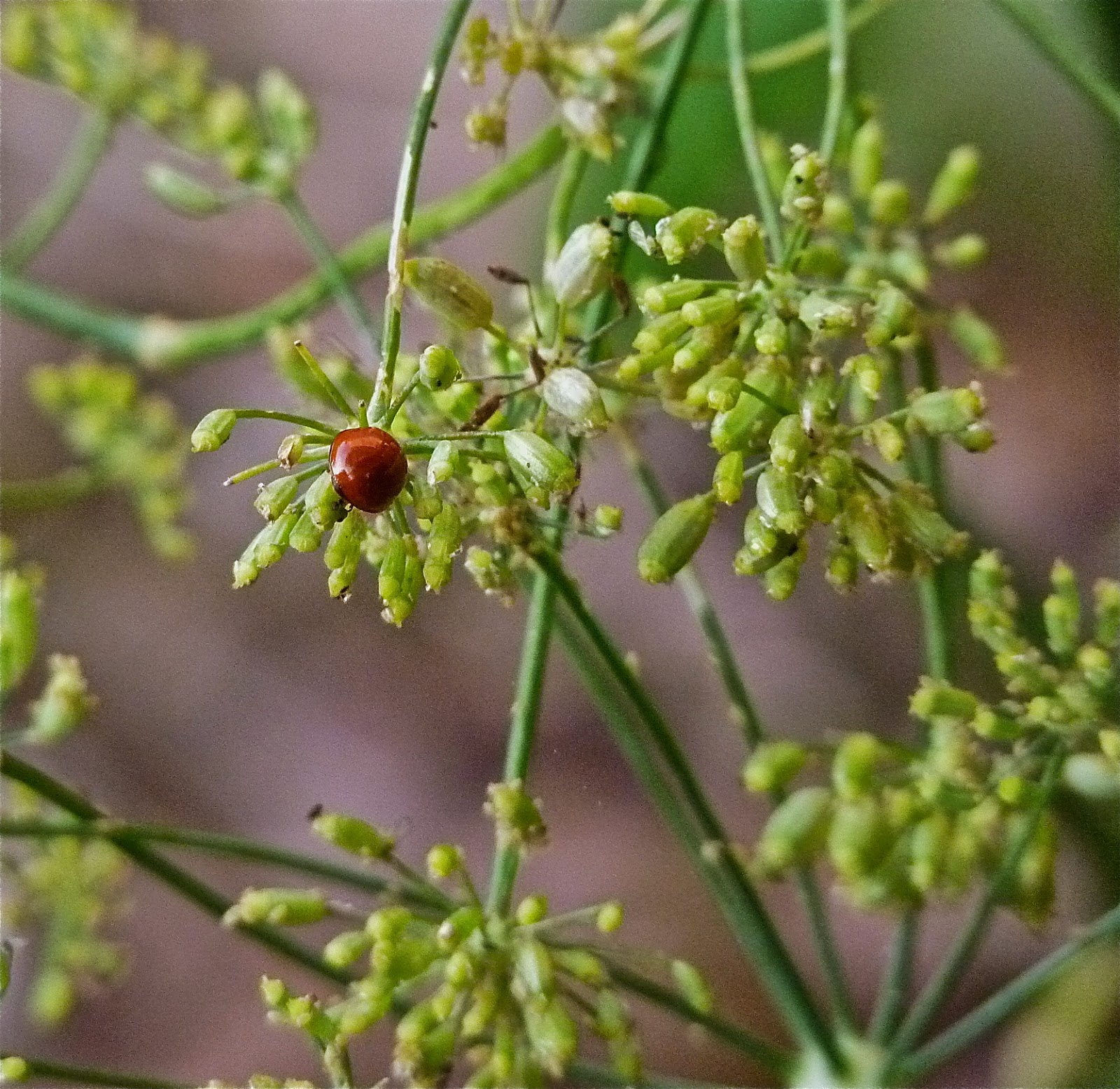
"OK," I thought to myself, "calm down, aphids are insect life too. Its totally cool the way the ants farm them, and maybe the little suckers will draw in some ladybugs.  Ladybugs are awesome.".

So this morning out I went with my camera, determined not to waste any more energy regretting what my fennel plants were not hosting, and to pay a little better attention to what was happening among the fronds.  I was not disappointed.
The usual suspects were there all right, aphids aplenty along with their farmer ants, but I also counted three or four eight-spotted forester moth caterpillars.

As I'd hoped for, with so many aphids in play, an adult ladybug was busy at work, eating her (his?) duly allotted five thousand plus aphids of the average ladybug's year long life span.
Also noted?  What I am pretty sure are Cryptolaemus montrouzieri larvae, which resemble a small mop head in action.  Looks like this one has something cornered there at the end of that frond.
These preferentially eat mealybugs and are indeed commonly called Mealybug destroyers, but the larvae especially will feed on aphids when that's the predominant bug on offer.
Cryptolaemus grow up to be another form of ladybug beetle, bicolored though unspotted, and as with their cousins, are native to Australia and New Zealand. They were introduced here as biologic control agents against agricultural damage caused by aphids, mealybugs, scale and the like.  The white stuff you see is a waxy substance excreted to discourage attacks, especially from ants, as the two insects have seriously competing interests concerning the best use of any given aphid population.

So maybe I don't have the targeted, coveted swallowtail caterpillars happily munching away on my aphid beleaguered fennel this year.  It is what it is. And I have seen swallowtail butterflies daily especially around our citrus plants.
Maybe I'll just wait a couple of weeks more before I count out the possibility of swallowtail caterpillars altogether.  Stranger things have happened.

This post is my contribution for August to Wildlife Wednesday, a new meme occurring the first wednesday of each month, fresh to the blogosphere and hosted by Tina at My Gardener Says. Thanks to Tina for hosting, and to you for reading. Glad you dropped by. Hope you'll feel free to post about your own wildlife, and join in on the fun. 

Per Tina:  "Post your wildlife wisdom, then leave a comment on this (My Gardener Says) blog along with a link to your blog so all can share in new information, experiences and maybe even some chuckles about wildness in our gardens!"