Welcome!

Welcome to austinagrodolce … My family and I garden with more intention and enthusiasm than allocated budget or overall design plan. It shows. Wildlife populations don't seem to notice our lack of cohesive design, they just like the native plants here. It seems by growing local we've thrown out a welcome mat. Occasionally, we're surprised at who (and what) shows up.


Showing posts with label Butterflies. Show all posts

Friday, April 29, 2016

Giving April her due

Time for a slightly different approach.
I find this passalong Pavonia consistently charming.
I don't have much to say today.
Didn't see the butterfly that laid the egg for this guy.  Fortunately my observation was not key to the process.
I did want to share a few recent images from the garden.
Cedar waxwings stuck around to fill up on loquats before heading north.
Intermittent rains both watered and kept the heat at bay through the end of April.

Plants and pollinators alike are happy about that.
Pollinators of every stripe have been happy to share the loquat bounty.
So am I.
Question Mark Butterfly, (Polygonia interrogationis) is a fan of the fermenting loquat fruit. 
My oak pollen "problem" is over for another year, though other trees continue their courtship dances in and on the wind.
I am able to enjoy my gardens from the other side of the windows again.
Here's to time spent outside with no more than the usual set of possible consequences.
Pipevine Swallowtail (Battus philenor) visits Lantana.
Fare thee well, April, here's looking forward to May!

Sunday, March 20, 2016

Happy Spring (or, the Swearin' O' the Green)

It is officially Spring!
I've had no luck with Indian Paintbrush but early appearing Tropical Salvia provide a substitute pop of true red.
In this part of the country, it is also Sneeze Season for anybody with a nose that objects to inhaling air laden with tree pollen.  It can be a true conflict.
With no real winter weather, these Turk's Caps are getting a head start on the season.

Tropical Salvia are usually still establishing rosettes after dying down to the ground over winter.  This year they are playing right along with the Springtime regulars, adding their subtle shades to the palette.
The desire to breathe freely through my nose without sneezing mostly keeps me indoors, but the exuberant show of wildflowers inevitably draws me back out.
Temperatures are all over the place.  90 degree highs one afternoon are followed two days later by highs in the low 70s.
Henry Duelberg salvia wilts in the heat.
  
From behind closed windows or out in person, it is a lovely time of year.

Our area ducked recent bouts of violent weather but lost out on chances for the rain that accompanied it.  Native wildflowers are stepping up to the plate, doing their best to shine with what little rain they get, at times peeking out over fallen leaves.
Evening Primrose nods over Live Oak leaves, soon to be followed by pollen catkins.
It is dry for March but water wise native plants don't care.  They see their opening, they take their shot.

In response, pollinators are everywhere.
In our area, having bees in your bonnet is a good thing.
Some of them too tiny to see from afar and easy to miss even close up.
This is a no-ID twofer.  Don't know the name of this little flowering plant, and can't positively ID the tiny bee visiting!
UPDATE:  Thanks to Tina (and family!) over at My Gardener Says for an ID boost.  The blooming plant is Golden Groundsel (Packera Obovata) and the tiny bee is likely a Ceratina or Perdita ignota.)
Metallic green sweat bees hover and finally alight to sample aloe vera pollen.


Another tiny bee, a bit less flashy, this one visiting Common Yellow Woodsorrel.

Much larger solitary ground and structure dwelling bees are emerging as well. This one spent hours visiting a Mountain Laurel in full bloom.


Not only bees, but butterflies are appearing.  Painted Lady butterflies, Vanessa cardui, are daily visitors.
This Painted Lady butterfly has seen better days but is clearly a bit of an escape artist.
Iconic Spring in Texas.  Painted Lady Butterfly resting on a fallen Live Oak leaf near Bluebonnets.


Not to be outdone, flower spiders are moving in early, establishing their "gotcha!" launch pads, ready for any fly-bys or sap sippers exhibiting more enthusiasm than experience.

Until I was editing this on my computer, I'd missed the spider hiding just behind unopened milkweed buds. Probably exactly the plan, hiding in plain sight.

Area lizards stake out sunny spots.  Posing for potential mates...
Pole dance anyone?
or stretched out impressively, warming bodies chilled by overnight lows.

Local rock star - a Texas spiny lizard
Nests and nesters abound. It is a busy time and procreation is in the cards for the lucky.
Two Carolina wrens spent days getting this nest tucked up right over our main egress to the back deck.  We've switched to a different door for the duration, hoping to disturb as little as possible..
Paper wasps are building everywhere, requiring constant trips to procure needed pulp.  This bench must seem like a real jackpot resource wise.
Leaning in, wasp style.


Weather assisted or assaulted, the persistence of life is in beautiful evidence everywhere.
I thought I'd gotten all this Bristly Mallow out.  Clearly that was an optimistic assessment, but I'll enjoy the flowers for a few more days before going after this aggressive ground cover.

Happy Spring to you!  May all the blooming, nesting, buzzing, chirping days yet to come be filled with joy and beauty, wherever you are.  

Thursday, October 15, 2015

Second Spring has Sprung

Texas gardeners especially appreciate October's tradition for easing the remnants of summer's heat. Afternoon highs may resist, but the temperatures at night will steadily move down, shifting the average temperature for each day towards a cooler set point.  Rain may be part of the transition, but more reliably it is moderated temperatures bringing relief.  Referred to as a Second Spring, markers for the seasonal change abound, natural and not-so.

Central Texas lacks autumn's semaphore of tree leaves turning, but the hazy smoke from seasonal slash and burn agricultural fires set far to our south regularly drifts our way in October, setting morning clouds ablaze.
Dramatic color is also on offer from other more natural sources. 
Argentinian native Oxblood lilies (Rhodophiala bifida) popped out flower stalks several times in succession this year, extending the pleasure of their deepest reds to span several weeks.  

Native plant Goldeneye (Viguiera dentata - a member of the Aster family) demonstrates mastery of this season, attracting pollinators of every sort to banks of blossoms with petals that face the sun's light. 
Warm color is transformed into sustaining matter.

Such exuberance is hard to resist.
Few try.  Days are shortening and whatever comes next, this is the season to forage and store. This Funereal Duskywing butterfly (Erynnis funeralis) shared the wealth with several types of bees.
Old favorites mix with new.  Native Chile Pequin aka Bird pepper plants (Capsicum annuum) develop tiny white flowers that faintly echo fellow native A. Duelberg salvia (Salvia farinacea) flowers growing behind.  The pepper plants offer a banquet for every visitor with blooms and berries appearing all at once. 
The addition of Crag Lilies (Echeandia flavescens) reinforces the wisdom of planting native perennials.  Their combination of strength and delicacy is exquisite.
The form of the flowers reminds me a bit of Columbine offering a similar swept-back display evoking fireworks. I'm quite smitten!
Also new here this season are Gregg's mist flower (Conoclinium greggii, another Aster family member), bringing a poignant shade of light purply blue to Fall's otherwise mostly golden palette.
Not to be outdone, Prairie verbena (Glandularia bipinnatifida var. bipinnatifida) are cautiously re-emerging now summer's worst is behind us, adding more complementary purple to play against the yellows and oranges. Appreciation is widespread. This skipper, I believe another Duskywing, was thoroughly working what few blooms were around.
Having survived aphids, tropical milkweed (Asclepias curassavica) rises above a background of truer blue H. Duelberg salvia (Salvia farinacea).  The milkweed are blissfully unaware of the roiling controversy as to whether or not their presence when planted out of their native region, offers any true lifeline to migrating butterflies.
It is difficult for me to appreciate the beauty of milkweed and simultaneously view them as a disease vector. As I get very few (Zero so far and counting) migrating monarchs, I've left mine standing for now.  Anoles (Anolis carolinensis) seem unimpressed by the controversy or my dithering.
Garden center pepper plants begin renewed production efforts in recognition of and appreciation for our cooler nights.  The anoles and I keep a close eye.  I watch for peppers to pickle while they are on the lookout for visitors who might provide more immediately pleasurable mouthfuls.  
Thai basil (Ocimum basilicum var. thyrsiflora) bloom spikes appear, bearing purple pagodas.  Earlier in the season I routinely pinch off blooms but these October spires will remain, filled as they are with the makings for seeds to yield future plants. Once developed, the seeds are also a favorite snack for finches.
No use of the term "favorite" could be reasonably made without the inclusion of this October stalwart, the bright pink flowers of Coral Vine (Antigonon leptopus).  Though designated "invasive" in Texas, this fall blooming vine has remained growing in restraint against a trellis here for over a decade with no sign of spread or reseeding.  
An equal draw for bees to any plant currently blooming, I decided to let this iteration of the vine stay in place.  My ongoing removal efforts will continue to focus on other problematic plants displaying more reproductive oooomph.  
October in Texas.  Filled with fests and fĂȘtes, it is a favorite time of year for locals and visitors alike. We are not known for arboreal color this season, but there is certainly no lack of beauty on display for the discerning eye.

Monday, September 28, 2015

September 2015 Butterfly Bucket List - Fiery Skipper

I'm joining up today with Anna of The Transmutational Garden for her monthly Butterfly Bucket List meme.
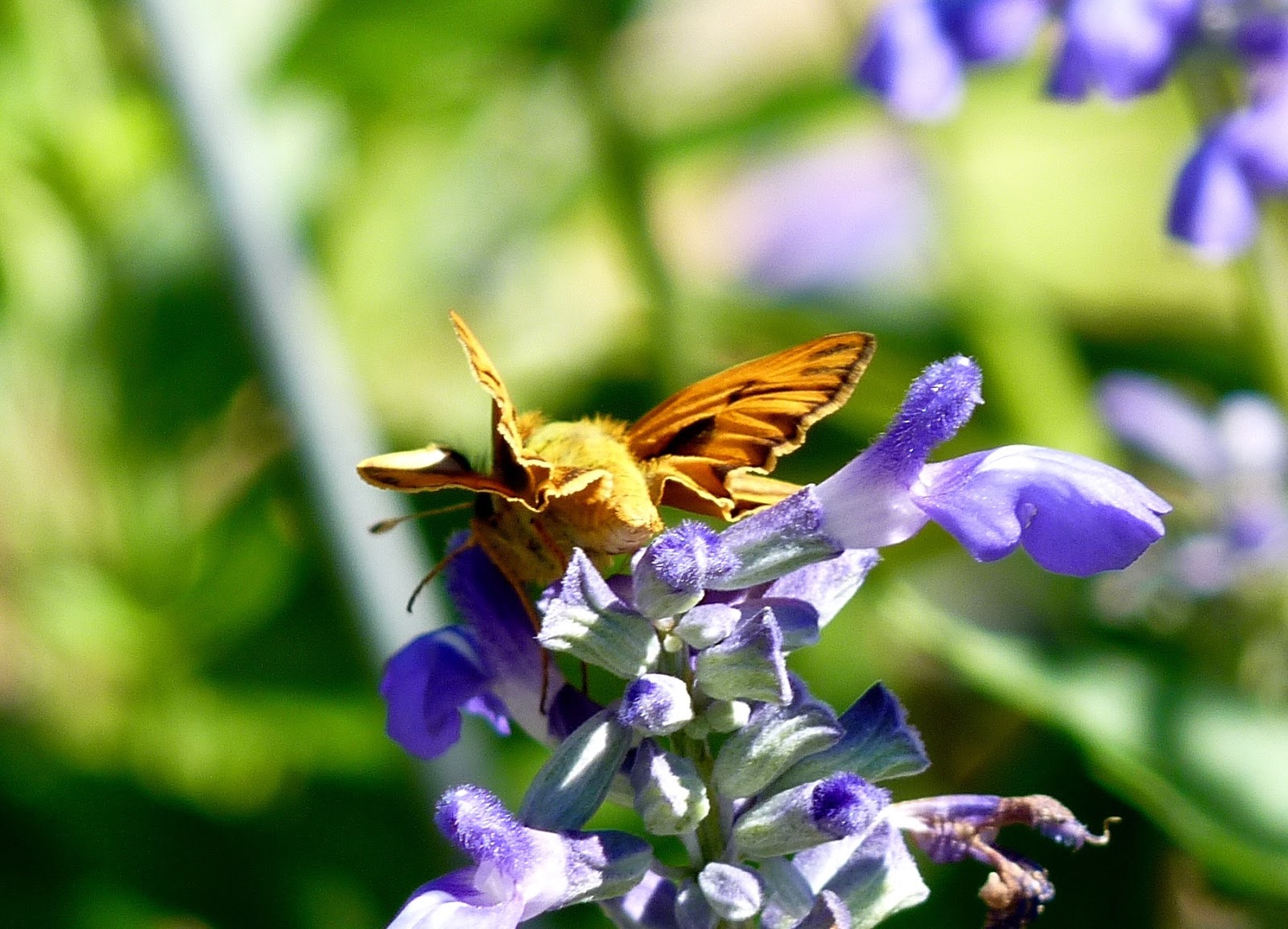
This month I can present with confidence, courtesy of identification provided by the friendly folks at Bug Guide.  Ladies and gents, I'm pleased to introduce Mr. Fiery Skipper (Hylephila phyleus).
A form of Grass Skipper (Hesperiinae), this little guy may have been a caterpillar in our own small patch of residual St. Augustine, however it is just as likely he was laid as an egg and then fed on as a caterpillar any of a number of Bermuda clumps I'm constantly finding.  Or crab grass.
While The Hub takes it personally when critters chew on his small patch of lawn, I'm more than happy to share ALL our Bermuda and Crab grass clumps with these tiny charmers!
Less than an inch long, these little guys are in near constant motion, so I was happy to get a few shots while this male was distracted by delicious nectar on Duelberg salvia and mint alike. Men! Give them their favorite beverage...
This is one of three different tiny yellow-orange skipper butterflies I saw for several days running, each of which was readily confused for the others to my amateur eyes.  I won't presume to point out identifying characteristics, but will encourage you to visit the links provided for further photos and information.

Common here due to mild winters and lots (and LOTS!) of grassy areas, the eggs are laid individually on grass stems, which the caterpillar rolls and lays out horizontally for protection.  After pupating, males tend to stake out likely areas to attract females, while the ladies take off in search of Mr. Right.
The Fiery Skipper! Tiny perhaps, but with a presence powerful enough to put this garden blogger on her knees in the grass, crawling to get a shot.  Thanks to Anna for encouraging all of us to go beyond admiration. It is always an adventure finding out who these amazing creatures are that grace our gardens.