Welcome!

Welcome to austinagrodolce … My family and I garden with more intention and enthusiasm than allocated budget or overall design plan. It shows. Wildlife populations don't seem to notice our lack of cohesive design, they just like the native plants here. It seems by growing local we've thrown out a welcome mat. Occasionally, we're surprised at who (and what) shows up.


Showing posts with label Skippers. Show all posts

Monday, September 28, 2015

September 2015 Butterfly Bucket List - Fiery Skipper

I'm joining up today with Anna of The Transmutational Garden for her monthly Butterfly Bucket List meme.
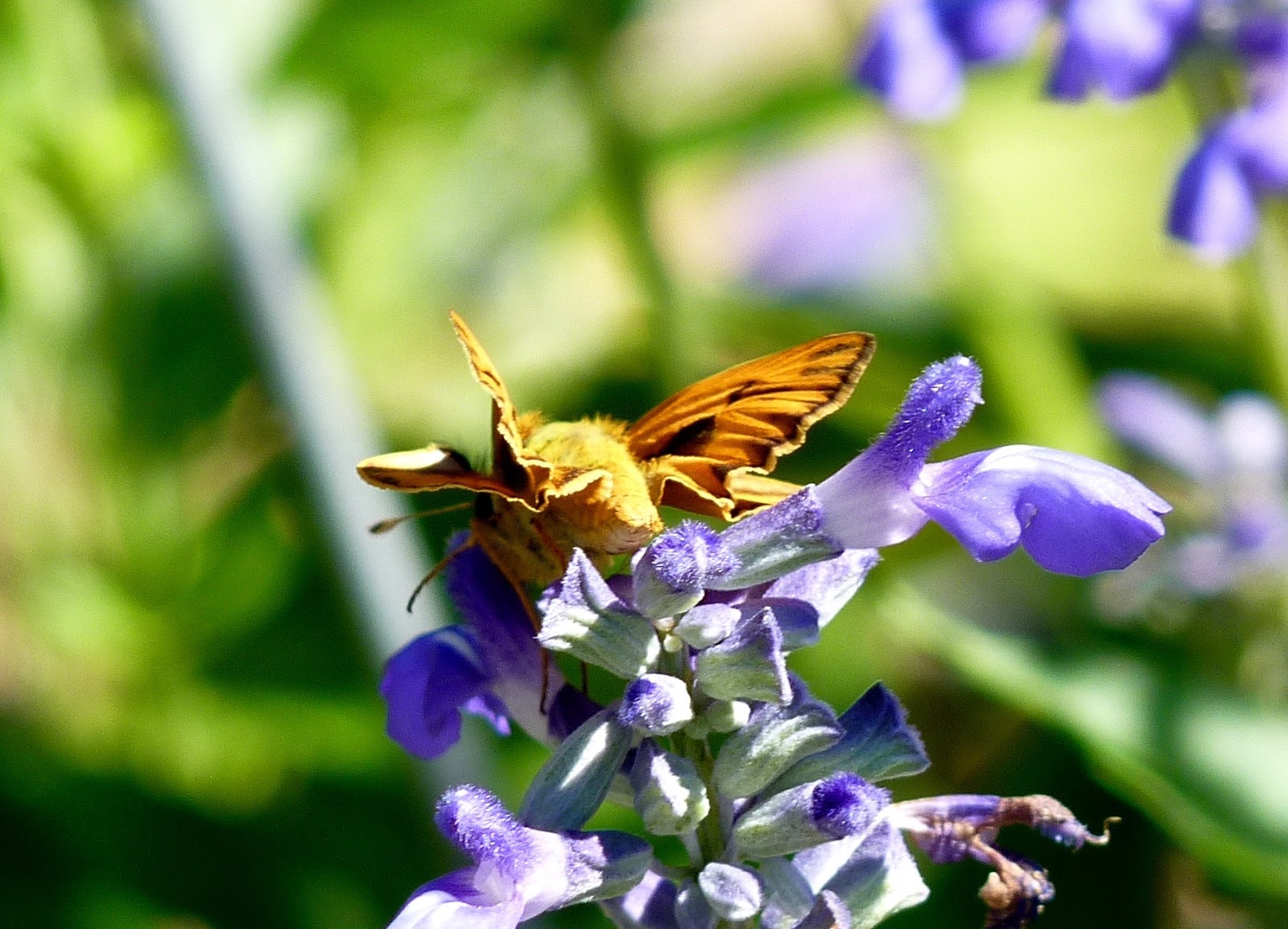
This month I can present with confidence, courtesy of identification provided by the friendly folks at Bug Guide.  Ladies and gents, I'm pleased to introduce Mr. Fiery Skipper (Hylephila phyleus).
A form of Grass Skipper (Hesperiinae), this little guy may have been a caterpillar in our own small patch of residual St. Augustine, however it is just as likely he was laid as an egg and then fed on as a caterpillar any of a number of Bermuda clumps I'm constantly finding.  Or crab grass.
While The Hub takes it personally when critters chew on his small patch of lawn, I'm more than happy to share ALL our Bermuda and Crab grass clumps with these tiny charmers!
Less than an inch long, these little guys are in near constant motion, so I was happy to get a few shots while this male was distracted by delicious nectar on Duelberg salvia and mint alike. Men! Give them their favorite beverage...
This is one of three different tiny yellow-orange skipper butterflies I saw for several days running, each of which was readily confused for the others to my amateur eyes.  I won't presume to point out identifying characteristics, but will encourage you to visit the links provided for further photos and information.

Common here due to mild winters and lots (and LOTS!) of grassy areas, the eggs are laid individually on grass stems, which the caterpillar rolls and lays out horizontally for protection.  After pupating, males tend to stake out likely areas to attract females, while the ladies take off in search of Mr. Right.
The Fiery Skipper! Tiny perhaps, but with a presence powerful enough to put this garden blogger on her knees in the grass, crawling to get a shot.  Thanks to Anna for encouraging all of us to go beyond admiration. It is always an adventure finding out who these amazing creatures are that grace our gardens.  

Wednesday, August 5, 2015

Wildlife Wednesday - Mad Dogs and Garden Bloggers

August is upon us and though some long for summer days to last forever others are more than willing to welcome the beginning of the end of the heat in the central Texas area.

There have been a lot of dragonflies and butterflies this year, due at least in part to heavier than usual May and June rains.  These evocatively named Widow Skimmers, this one a male, according to the blue body, have provided near constant supervision and companionship out in the garden beds.

Skipper butterflies continue to visit daily, their erratic flight patterns reminding me of Charles Schulz's flittering companion for Snoopy, the adorable Woodstock.  Yes, Woodstock is a bird, a little yellow bird, but besides his random low-level aviation preferences (he got beak bleeds if he went too high) you may recall Snoopy pulling out a field guide and attempting to identify Woodstock, to no avail.  

I'm not sure the artist ever actually identified Woodstock "as" any specific bird. Snoopy gave up his attempt with a shrug. The point was not "what" Woodstock was, other than being Snoopy's close companion.

I can relate.  At times knowing is important.  Other times...not so much.

Here, what I think is a Sachem Skipper busily nectaring on a coneflower, while another different type of skipper butterfly can be seen clambering up onto the business end of a second bloom in the background.  
Coneflowers are an ongoing steady draw for skippers and other butterflies. Beautiful at every stage, these dramatic late bloomers fill in just as other flowers are fading for the season.

As well as attracting pollinators to their flowers, finches are drawn to the developing coneflowers seed heads. 
This Lesser Goldfinch might have been hungry when he got here, but there was no reason to leave that way.  This one could have been after the seed heads of some blanketflower nearby.  After snapping this I retreated rather than interrupt.  Finches can be shy, as behooves a bird small enough to perch easily on a flower stem.

Speaking of shy, the spiny lizards have sure been out in numbers all around our area.  Over the years we'd spot one or more of these a couple of times a season so we always knew they were around, but this summer we are seeing them daily, if only for a moment and often only as they are skittering to whatever feels like safety.
I think they are quite handsome, and hope their population micro-explosion continues.  I'm not sure what they feed on, I've purposefully avoided seeking that information out.  I'd rather enjoy the idea they are here without "knowing" what they eating.  In my horticultural haven, everything eats unspecified garden pests.  So let it be written...

Spider webs were absolutely everywhere all July long, and the entrance of August has not seen much of an abatement.  There are scads of messy webs in the tips of lots of tree and small shrub branches, originally leading me to believe we'd been invaded by web worms.  Closer inspection revealed they are webs sans worms.
They make for interesting photos as the webbing renders like a loss of focus by the camera lens.  I'm demanding all my future photographic portraits be shot through this stuff.
Here's an example of what I think of when I think of spider webs, the more traditional intersecting silk gridwork.  I wasn't able to capture the iridescence of this as it undulated in the morning breezes. the camera only able to "see" one color wavelength at a time.   

I've always wondered if spiders appreciate their work for being attractive as well as functional? Can't you just imagine a group of spiders gathered to critique each other's efforts?  The mouthy one (there's one in every group) is holding forth "So here is where Francesca went a little off grid, commenting on the disorganization of modernity as superimposed.." while Francesca leans over to the spider next to her to whisper "That is where I trapped and wrapped my dinner.  Disorganization of modernity, my ass!". 

In the very last days of July, I ended up taking a series of shots attempting to capture the antics of a pair of tufted titmice. I first noticed one bird hunting insects all around the Candyland bird bath.
This guy hunted for bugs in the water, and then went after a couple of unguarded wasp nests over the kitchen window.  At that point he was joined by a previously unseen hunting partner.  

The two of them investigated every clump of ball moss and patch of lichen in the oak trees overhead.  
They were nothing if not thorough.  Nobody is handing these guys anything, they worked hard, staying in near ceaseless motion.  
At least they're working in the shade.  It was 95 degrees when I took these and the temperature was still climbing.
And that is it for this August's Wildlife Wednesday.  Only mad dogs and wildlife garden bloggers go out in the sun in July and August, the bloggers no doubt working to chronicle fellow hot weather denizens for their own Wildlife Wednesday posts.  I hope you've enjoyed taking a quick peak at some of what is happening on the other side of all our lowered shades and closed curtains this time of year.   

Please note: all the identifications made here are my own amateur efforts unless specifically credited to another source.  If you are pretty sure I've labeled something incorrectly, feel free to point that out in the comments section.  We'll all feel better afterwards if you do, or at least I certainly will!   

- - - - - - - - - - - - - - - - - - - - - - - - - - - - - - - - - - - - - - - - - - - - - - -
Thanks to the remarkable Tina at My Gardener Says for hosting the first Wednesday of each month's  Wildlife Wednesdays.  As she notes,  "A garden is never so alive and vibrant than when it is graced by wildlife." Be sure to visit her amazing blog and discover the potential rewards of enjoying your very own garden spaces along with the creatures who depend upon them for their daily sip, seed, or bug.   

Wednesday, July 1, 2015

A little wet means a lot of wild in Texas

Welcome to Wildlife Wednesday for July, 2015.  I am finding I have less and less to say about our garden beds and the lives that are led there.  Recently it has occurred to me the best I can do for our tiny patch of the world is to slowly repopulate the spaces with native plants and other well adapted visitors that feed the usual suspects, and then let Mother Nature have her head.  She always knows just what to do.
If you see a black swallowtail doing this...
Pretty soon you'll see these, eventually followed by...
One of these, newly emerged and drying out its wings.
This flower spider didn't bother the other big players.  This palpita moth was never in jeopardy.
Not sure what fuzzy wuzzy is destined to become.  As long as he/she knows, it'll be fine.
Handsome is as handsome does...  I'm currently in determined "no look-up" mode, only wanting to enjoy what I'm seeing without researching any further.
Tarantula Hawks apparently always run.  It was hard to get a photo even though this guy is two inches long.
Katydid nymphs are wonderfully spotted and dotted.
Fat and in no particular hurry. 
Not the reason I put the first tomato cage out but the reason I put out two more...
Blanketflower seed head post finch feasting.
Steel Blue Cricket Hunter Wasp.  Good hunting to you sir!

Little brown skipper.  I love how serious this one appears.  
Thanks to blogger Debra at "Under the Pecan Leaves, I know this is a Male "Widow" Skimmer (blue body).
I think this is a blue dasher.  (not gonna look it up, NOT gonna look it up...)

Bitty baby black swallowtail cat on parsley.  No kitchen duty for this plant!
This ditch daylily is a magnet for native bees.  They dive right in.
Henry Duelberg gets regular visits from his many admirers.
Blue damselfly supervising.
I am deeply grateful for the chances I get to share our garden spaces with all sorts of wildlife.  Today I suppose that includes you! Though I occasionally chafe at all the nibbled leaves left behind, it is a small price to pay for the best of company.

I find the less I pretend at control, the more I enjoy my time out of doors.  Part of how that plays out is I now resist the impulse to do research associated with every image I capture with my camera.  For whatever reason, allowing myself to "not know" is helping me remember who these spaces are designed to serve.

- - - - - - - - - - - - - - - - - - - - - - - - - - - - - - - - - - - - - - - - - - - - - - - - - - - - - -
Thanks as always to Tina at "My Gardener Says" for hosting Wildlife Wednesday. Check out the comments section of her post for July to find links to amazing gardeners showcasing their wild visitors from all around.  Maybe you'll consider adding in your own wildlife experiences for the month.  Once you go "Wild" you'll never want to go back. Happy July everyone!

Sunday, April 12, 2015

The Good, the Bad, and the Bugly: Stripes, Splotches and Spots in the Garden

I have written time and time again of how frustrated I get when trying to accurately identify plants and all their visitors in our garden spaces.  Some identities are easy to establish, while other creatures provide me few distinguishing clues, elusive due to some combination of velocity, size, or relative rarity.

This caterpillar was fairly easy - rather less camouflaged next to a pile of pollen on my windshield than when it was when more intentionally located up above on the overhanging live oak branches.

The Catocala ilia caterpillar, recognized for its lichen mimicry, favors flowering oaks (Quercus) among others.  The adult moth is sometimes called a Beloved underwing, or Wife underwing.  As long as you don't over think things, that's kind of romantic, yeah?
Earlier this year I found the Lost Ladybug Project, where I read how ladybugs introduced to combat various agricultural pests may be out competing native populations.  I admit to releasing lady bugs into our garden spaces several times, but have no recollection if they were even labeled as to type. Since then I've been curious as to who "my" ladies are, so I've paid more attention to the numbers of spots on the beetles I've seen.
This counting job didn't take long.  Spotless, this is either Cycloneda polita or sanguinea. I never got a good look at the pronota (the part above the head between the head and wing coverings).  Going by the ranges shown for Texas, it is probably C. Sanguinea.
A grainier shot here from a different day featuring another spotless gal, but with a clear look at the pronota this time.  This beetle is probably a Polished Lady Beetle, Cycloneda munda, judging by the more orange color and light colored legs.

It's tricky, keeping track of visitors.  There are days I yearn for tiny name tags. As I learn to look for one characteristic, it seems I discover soon thereafter about other markings needed to identify with any real specificity.  At any rate, none of the beetles I've found this year so far are the native Nine-spotted Ladybugs researchers are currently monitoring. Introduced or not, they are all welcome here. I'm happy for any variety.

Less desirable perhaps but still striking in appearance, this leaf-footed bug, a member of some branch of the Coreidae family.
  
I rarely see just one of these.  Sure enough when I went back the next day to check, attendance had doubled.

Checking back a third time I was relieved the leaf-foot party of two had moved on.  If I found them gathering in large numbers I'd be tempted to intervene, and I'm trying to keep that to the bare minimum, seeing if systems won't balance out long run when left to their own devices.

Recently from across the yard I noted motion by a far corner of our lot.  I took a quick shot without really being able to see what I was trying to capture, figuring by the time I reached close-up range the kerfluffle causer would have left the scene.  Which it did, leaving me hanging until I could download the photo and get a closer look.

Cropping and enlarging revealed the culprit, a Texas spiny lizard  (Sceloporus olivaceus). Only occasionally do I catch a glimpse of these and even more rarely do I get a photo as they are fleet of foot and shy by nature.  Compared to the camera friendly anole, spiny lizards are the Greta Garbos of the garden.
Despite their rugged appearance, males competing for territory reportedly engage in rigorous push-up contests until one simply gives up and moves off. Pretty pacifistic of them, all things considered.  Females will lay clutches of eggs several times during the warm months, so I'm optimistic there are more of these around than the one or two I see.

Some butterflies are easy to identify. The Papilo glaucus, or Eastern tiger swallowtail, is comparatively huge, just difficult (for me) to capture in a photograph as this one was staying high in the tree tops.
This is obviously a female due to the behavior demonstrated (ovipositing, or egg laying) and additionally confirmed by the blue spots on the wing.

More ovipositing, this time by a Eight Spotted Forester Moth.  This one, like most of the ones I've observed in our yard, was favoring Virginia creeper as a host plant, but seemed fine with laying the occasional egg on pink evening primrose stems growing in and amongst the creeper.  Creeper adjacent must be good enough.
Another little visitor is this butterfly, what I think is a male Eastern tailed blue, or as more commonly named, a Gray Hairstreak (Stymon melinus). I thought it was a Reakirt's blue but ruled that out due to the orange patches. My confusion arose from usually seeing these with wings closed, plus the overhanging primrose is hiding most of the tail.
Continuing on in the Primroses Harboring The Harder to Identify category, I caught up with a couple of LBJ's, or Little Brown Jobs, shorthand applied to the multiple skipper butterflies that are tiny, fast, and often persistent in keeping their mostly brown wings closed whenever briefly at rest.  Most of them frustrate all my attempts at precise identification.

The second shot reveals glimpses of top and bottom wing surfaces which might have made for a more specified typing, but frustration builds, if you get my drift.  By the time I edited this photograph I had long passed the impatient point of no return.  If you know what this is, feel free to weigh in.  I'll only be relieved for the assistance, honestly.

I do take some small comfort in not being alone in my identification woes, at least when it comes to Skippers.  From the internet:

"Many species of skippers look frustratingly alike. For example, some species in the generaAmblyscirtes, Erynnis (duskywings) and Hesperia (branded skippers) cannot currently be distinguished in the field even by experts. The only reliable method of telling them apart involves dissection and microscopic examination of the genitalia, which have characteristic structures that prevent mating except between conspecifics.[1]"

Um, OK.  I think I left my dissection kit in my other pants, along with my butterfly genitalia microscope.  Ahem! Skipper it is, then, unspecified.

Speaking of unspecified, this tiny jewel of a beetle resisted all my attempts to find its niche in the realm of identified visitors.  I think of it as The Little Green Gorgeous and only hope it is not the first of some horde yet to come, or other well known (to everyone but me) pest I ought to have eradicated on sight.
Hardly larger than an ant, its entire body would fit within the curve of the small end of a standard paper clip.  I watched it chug along across the decomposed granite path, lost in admiration of its color and sheen.

Another set of even tinier feet trudging across the path belonged to this leaf litter ant, perhaps Ponera pennsylvanica?
Well camouflaged, it was hauling around a spherical seed, headed in no discernible direction due to the difficulty of taking any sort of a straight line with all the obstacles presented to a traveler that size.

And now, to close...  What, you didn't think I'd end a post about fauna in the flora without the obligatory anole portrait did you?  
There.  I feel much better now.

I realize I gripe a lot.  I'm really experiencing more fascination than frustration.  So far, paying closer attention to the full variety of beauty (and occasional beast) has been its own reward.  I hope you've enjoyed taking a closer look, too.  Happy trails!