Welcome!

Welcome to austinagrodolce … My family and I garden with more intention and enthusiasm than allocated budget or overall design plan. It shows. Wildlife populations don't seem to notice our lack of cohesive design, they just like the native plants here. It seems by growing local we've thrown out a welcome mat. Occasionally, we're surprised at who (and what) shows up.


Showing posts with label Flora and Fauna. Show all posts

Friday, April 29, 2016

Giving April her due

Time for a slightly different approach.
I find this passalong Pavonia consistently charming.
I don't have much to say today.
Didn't see the butterfly that laid the egg for this guy.  Fortunately my observation was not key to the process.
I did want to share a few recent images from the garden.
Cedar waxwings stuck around to fill up on loquats before heading north.
Intermittent rains both watered and kept the heat at bay through the end of April.

Plants and pollinators alike are happy about that.
Pollinators of every stripe have been happy to share the loquat bounty.
So am I.
Question Mark Butterfly, (Polygonia interrogationis) is a fan of the fermenting loquat fruit. 
My oak pollen "problem" is over for another year, though other trees continue their courtship dances in and on the wind.
I am able to enjoy my gardens from the other side of the windows again.
Here's to time spent outside with no more than the usual set of possible consequences.
Pipevine Swallowtail (Battus philenor) visits Lantana.
Fare thee well, April, here's looking forward to May!

Thursday, October 15, 2015

Second Spring has Sprung

Texas gardeners especially appreciate October's tradition for easing the remnants of summer's heat. Afternoon highs may resist, but the temperatures at night will steadily move down, shifting the average temperature for each day towards a cooler set point.  Rain may be part of the transition, but more reliably it is moderated temperatures bringing relief.  Referred to as a Second Spring, markers for the seasonal change abound, natural and not-so.

Central Texas lacks autumn's semaphore of tree leaves turning, but the hazy smoke from seasonal slash and burn agricultural fires set far to our south regularly drifts our way in October, setting morning clouds ablaze.
Dramatic color is also on offer from other more natural sources. 
Argentinian native Oxblood lilies (Rhodophiala bifida) popped out flower stalks several times in succession this year, extending the pleasure of their deepest reds to span several weeks.  

Native plant Goldeneye (Viguiera dentata - a member of the Aster family) demonstrates mastery of this season, attracting pollinators of every sort to banks of blossoms with petals that face the sun's light. 
Warm color is transformed into sustaining matter.

Such exuberance is hard to resist.
Few try.  Days are shortening and whatever comes next, this is the season to forage and store. This Funereal Duskywing butterfly (Erynnis funeralis) shared the wealth with several types of bees.
Old favorites mix with new.  Native Chile Pequin aka Bird pepper plants (Capsicum annuum) develop tiny white flowers that faintly echo fellow native A. Duelberg salvia (Salvia farinacea) flowers growing behind.  The pepper plants offer a banquet for every visitor with blooms and berries appearing all at once. 
The addition of Crag Lilies (Echeandia flavescens) reinforces the wisdom of planting native perennials.  Their combination of strength and delicacy is exquisite.
The form of the flowers reminds me a bit of Columbine offering a similar swept-back display evoking fireworks. I'm quite smitten!
Also new here this season are Gregg's mist flower (Conoclinium greggii, another Aster family member), bringing a poignant shade of light purply blue to Fall's otherwise mostly golden palette.
Not to be outdone, Prairie verbena (Glandularia bipinnatifida var. bipinnatifida) are cautiously re-emerging now summer's worst is behind us, adding more complementary purple to play against the yellows and oranges. Appreciation is widespread. This skipper, I believe another Duskywing, was thoroughly working what few blooms were around.
Having survived aphids, tropical milkweed (Asclepias curassavica) rises above a background of truer blue H. Duelberg salvia (Salvia farinacea).  The milkweed are blissfully unaware of the roiling controversy as to whether or not their presence when planted out of their native region, offers any true lifeline to migrating butterflies.
It is difficult for me to appreciate the beauty of milkweed and simultaneously view them as a disease vector. As I get very few (Zero so far and counting) migrating monarchs, I've left mine standing for now.  Anoles (Anolis carolinensis) seem unimpressed by the controversy or my dithering.
Garden center pepper plants begin renewed production efforts in recognition of and appreciation for our cooler nights.  The anoles and I keep a close eye.  I watch for peppers to pickle while they are on the lookout for visitors who might provide more immediately pleasurable mouthfuls.  
Thai basil (Ocimum basilicum var. thyrsiflora) bloom spikes appear, bearing purple pagodas.  Earlier in the season I routinely pinch off blooms but these October spires will remain, filled as they are with the makings for seeds to yield future plants. Once developed, the seeds are also a favorite snack for finches.
No use of the term "favorite" could be reasonably made without the inclusion of this October stalwart, the bright pink flowers of Coral Vine (Antigonon leptopus).  Though designated "invasive" in Texas, this fall blooming vine has remained growing in restraint against a trellis here for over a decade with no sign of spread or reseeding.  
An equal draw for bees to any plant currently blooming, I decided to let this iteration of the vine stay in place.  My ongoing removal efforts will continue to focus on other problematic plants displaying more reproductive oooomph.  
October in Texas.  Filled with fests and fĂȘtes, it is a favorite time of year for locals and visitors alike. We are not known for arboreal color this season, but there is certainly no lack of beauty on display for the discerning eye.

Wednesday, October 7, 2015

October Wildlife Wednesday - Autumn's abundance

In Texas it is commonly held wisdom September is the survival point signifying the turning of the seasons, the pivot between the last heat of summertime and the first cool mornings of autumn. While the arrival of our transition to "cooler" felt delayed this year, September yet offered a sure progression towards that goal.

Maybe I only imagine the wild populations or numbers of visitors increase in response, but definitely we are outdoors more, enjoying what is often the nicest weather of the year.  Perhaps all the wild visitors for this ninth month on our calendar are reporting back in to their own, "the people are often spotted exiting their hive".  While advising each other to watch for "clear signs of agitation", "these people are harmless if not threatened".

Our cats are certainly paying attention.  They enjoy observing their favorite and near constant companions from behind closed or screened windows and doors.  Carolina wrens begin these shared sessions by fuss-fuss-fussing at the cats, breaking off eventually to hunt. They spend several minutes searching for bugs, spiders, and bits of web, looking intently into every nook and cranny all around our back deck.
Carolina chickadees are often seen at the feeder.  Both bird sightings trigger much cat crouching, skulking from window to window, and excited vocalizations.  Occasionally the tension builds to some agreed upon level at which point the cats unceremoniously smack each other in the face a couple of times and then call it quits, moving off for a nap.  The birds remain unimpressed.
Moving from feather to fin, this fine specimen of a Texas spiny lizard seemed to be posing, assuring I could capture his best angle and absorb the full impact of his blue patched glory.

I involuntarily spoke aloud when I first noticed this guy.  (I'm assuming maleness based upon his blue patches.)  I could not contain my pleasure at seeing him here, which was only surpassed by my appreciation for his staying still while I quietly approached.  Now I'm the number one member of his fan club.  I think he is magnificent.

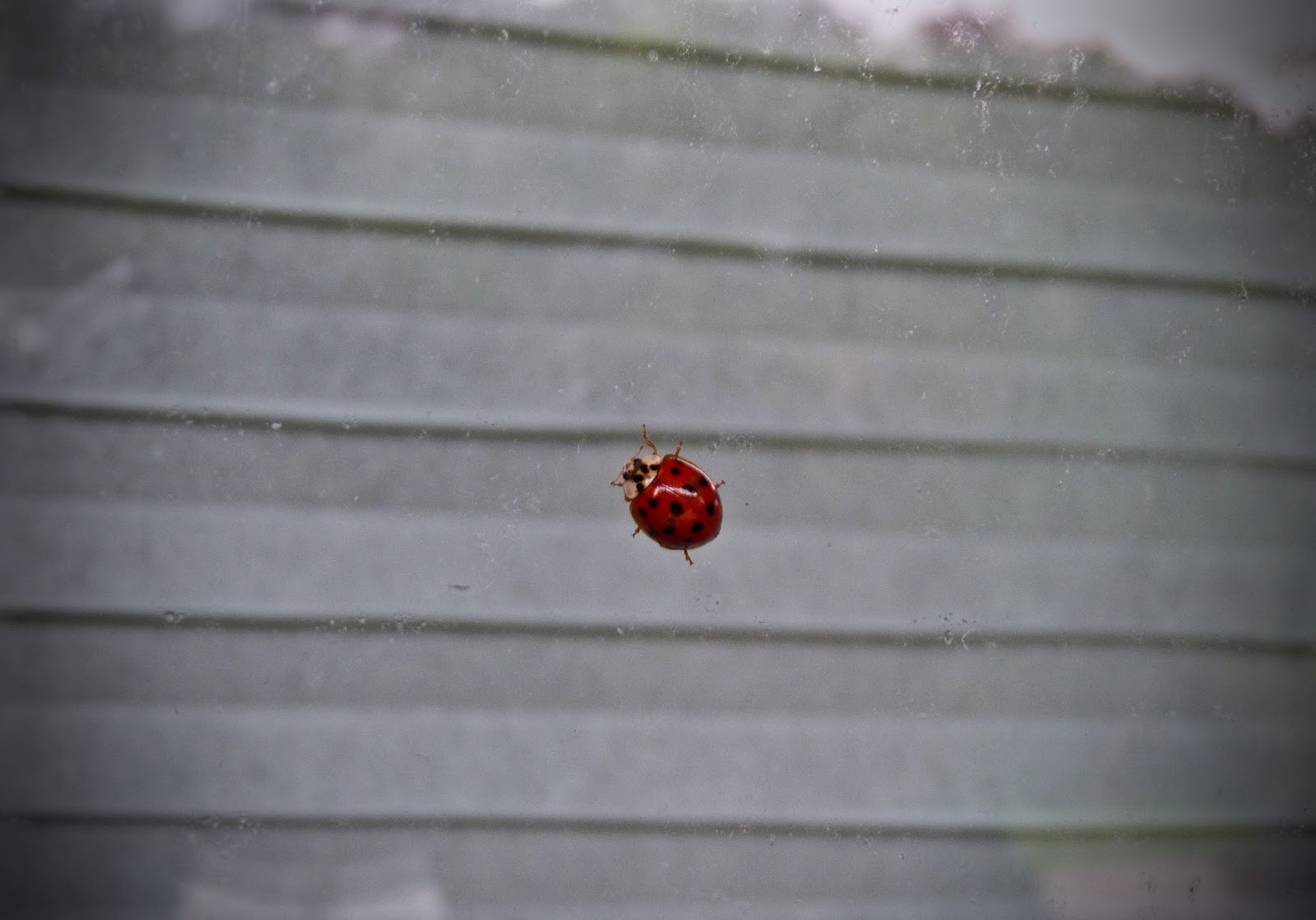
We've got aphids aplenty this September, which eventually draws in ladybugs. The one in my photo is an import, Harmonia axyridis, and as such is no longer heralded. I struggle with that. I appreciate any help in keeping aphid numbers in check without my having to look very closely at or touch them personally.  

I understand these are imported lady beetles and they are taking habitat away from native lady beetles. I know this on an intellectual level, yet whenever I see a ladybug (as I grew up calling them) they uniformly trigger a response of affectionate regard.  Stopping to count the spots and realizing any particular bug in question is imported, does not serve to interrupt the emotional connection I immediately establish with the very "idea" of ladybug.
I'm always shaking my head that I don't get "many" butterflies, but when I take stock of September I see that isn't precisely true.  While I don't get masses visiting, and I don't see many migratory butterflies, I do have a steady handful of locals showing up to visit whatever is in bloom.
Fiery Skipper on H. Duelberg salvia
In September that is mostly the salvias, though mint I keep on hand serves as a reliable draw each year.  I pull most of the mint out annually but there are always sprigs that survive and I hand water them in August to encourage these popular flowers.
Fiery Skipper on mint
Gray Hairstreak on mint
Southern Skipperling on mint
I planted blue mistflower to pull in queen and monarch butterflies, but it is attractive to smaller native orange specimens as well.  Skippers and skipperlings exhibit a preference for my blue flowers, allowing me to enjoy their company and not fret that my floral efforts are being overlooked.
Southern Skipperling on Mistflower
This past month I spotted several bees, some of them up to what might be considered impolite behavior in human circles.  But they are bees after all, and as noted in the song, "birds do it, bees do it..".

You've been warned.
Xylocopa tabaniformis, tabaniformis-ing.
Ahem! Moving along, a common (and by comparison so petite and so polite) visitor, the European honeybee, visiting mint...

and a not so common sight in my gardens previously, the Xylocopa micans carpenter bee.  These guys are so heavy they usually bend whatever flower spike they are visiting waaaaay over.  I was able to get this photo because I have this H. Duelberg salvia growing up through a tomato cage.
Carpenter bee, specifically Xylocopa micans.  
The cage was originally placed to support blanketflower seed stalks for finches.  Left in place out of laziness, it is now making it easier to observe heavy pollinators all the time and all the pollinators on breezy days.  Lesson learned.  I'll put the cages out and leave them there on purpose, from now on.

Syrphid flies look like bees and serve much the same purpose as bees, so I wonder why it is we don't know more about them or admire them more widely? They need a better publicist.
Most of the darners and dragonflies I saw in September were on the wing but this one Blue-ringed Dancer damselfly cooperated and posed nicely.
There were a few other new (to us) visitors.  These Large Milkweed Bugs...Oncopeltus fasciatus...
attractively color coordinated with their Tropical Milkweed host, were busily shopping for mates.  Heeding the debate, I'm wondering about the need for cutting my milkweed back the moment I hear of monarch migrators in our area.  Either way it is reportedly not desirable for these milkweed bugs to successfully establish a nursery as their presence in numbers may deter butterflies.  Even if I leave the tropical milkweed growing at all, I'm still hoping to get native milkweed plants established, which the milkweed bugs would also readily colonize.  Rather than let them distribute eggs, I dispatched them.

This similarly fashionably coordinated fellow has two names, both of them longer than he is.  This is a yellow margined flower bup, or Acmaeodera flavomarginata (part of a family of wood boring beetles). 
This Scolia dubia, also called a blue-winged wasp, dropped in on the Kidneywood tree while it was in full bloom.  I was delighted to read they predate June Bug and Japanese beetle grubs.
I've had some rough history with wasps recently.  Impressive in size, I kept a respectful distance from this one until I determined it was not only unthreatened, but past that resolutely uninterested in my presence.

One of the weirdest visitors to our spaces in September was this Walking Stick, type unknown.
While it impressed me as being six to seven inches long, when I investigated information readily available on giant walking sticks, I came up with nothing and nobody who even vaguely resembled this guy.  I found multiple photos and reports of these insects being tame and easily handled, but when I went back out to get more photos and perhaps a measurement or two, my specimen-to-be had (wisely) vanished.  Identity crisis obligation for the month... met!

And of course there is always drama lurking in the wings.  I was snapping shots of a hoverfly demonstrating why it deserves the name, wondering if it was eying the aphids as deterrent, potential competition or perhaps even as a potential meal.

Maybe the aphids and the hoverfly were deep in conversation?  The hoverfly circled and stopped, circled and stopped. When I happened to glance further down the stem I noticed another set of what seemed to be hungry eyes.
An anole! Who was after whom?  The fly moved on, the aphids stayed put, the anole ate...something...or to the rest of its kind, somebody.  It all happened too quickly for me to see.  I'm guessing some aphid-tending ant met its end as the rest of the world kept wheeling relentlessly by.

Happy Fall to those of us who are currently enjoying a return to cooler times, and Happy Wildlife to all, no matter your weather or season.  
- - - - - - - - - - - - - - - - - - - - - - - - - - - - - - - - - - - - - - - - - - - - - - - - - - - -
Thanks as always to the inspirational Tina of My Gardener Says, creator of the Wildlife Wednesday meme and native plant/wildlife guru to us all.  Be sure to visit her post for this month and visit the comments section to find links to wildlife reports from around the globe.


Saturday, August 29, 2015

August Butterfly Bucket List- Zebra Longwing

I'd given up getting any sort of shot of a butterfly at all for the August Butterfly Bucket List hosted by Anna at The Transmutational Garden every 4th Sunday.  I was actually out taking photos today of some clumps of century plants that I have big (BIG!) plans for.

I was trying to get some good wide shots of the beds the century plants currently dominate, when I spotted a dragonfly I didn't recognize.  Off I went to get a photo (of course!) and while I was wheeling around it trying to get a good shot of any identifying marks, my attention was captured by a narrow winged strongly striped black and yellow blur in the background.
It was one of a handful of Texas butterflies I recognize on sight, a Zebra Longwing (Heliconius-charithonia).  I was elated! A sighting for August in the nick of time! In the spirit of the Bucket List, I decided it was time to fill in some gaps in my information on this wonderfully striped visitor.

According to the information on the BOMA page linked above, Zebra Longwings grow to a length of between 2 3/4 and 4 inches, wing tip to wing tip.  Their preferred host plant is any one of the several varieties of passion vines.  I found it fascinating that such a strongly patterned winged creature flies around leaving eggs and setting their cats loose on vines bearing one of the most striking flowers around.
The adults feed on lantana and shepherd's needle preferentially.  I'd never heard of shepherd's needle previously (a parsley relative - butterflies of all stripes do love the parsleys) but we have loads of lantana around as evidenced in the photos today.

Zebra Longwings are reported to have a set foraging route.  They are considered "trap-line" feeders.  That means since I saw one out on our lantana this afternoon, if I am observant I ought to be able to catch it visiting again tomorrow.  And the next day.  I like that idea - that the zebra and I have a standing appointment, if I wish to keep it.
What I found really intriguing, is that adults roost communally in groups of 25-30 individuals.  I can barely imagine what that might look like, a cluster of 2-3 dozen of these beauties all in one place at one time.  It would be like winning the butterfly lottery - a bonafide Zebra Longwing Jackpot!
So, take that, August.  While I barely made the cut this month I am optimistic the return of slightly cooler temperatures and at least a chance for precipitation will see our winged visitors showing up in numbers again soon.

Thanks to Anna for hosting this wonderful incentive to get out and take a closer look at who is flying in and dropping by.  Be sure to visit her own August post and pick up the links to a whole host of great bloggers posting about their own butterfly experiences this month.