Welcome!

Welcome to austinagrodolce … My family and I garden with more intention and enthusiasm than allocated budget or overall design plan. It shows. Wildlife populations don't seem to notice our lack of cohesive design, they just like the native plants here. It seems by growing local we've thrown out a welcome mat. Occasionally, we're surprised at who (and what) shows up.


Showing posts with label Seasons. Show all posts

Sunday, March 20, 2016

Happy Spring (or, the Swearin' O' the Green)

It is officially Spring!
I've had no luck with Indian Paintbrush but early appearing Tropical Salvia provide a substitute pop of true red.
In this part of the country, it is also Sneeze Season for anybody with a nose that objects to inhaling air laden with tree pollen.  It can be a true conflict.
With no real winter weather, these Turk's Caps are getting a head start on the season.

Tropical Salvia are usually still establishing rosettes after dying down to the ground over winter.  This year they are playing right along with the Springtime regulars, adding their subtle shades to the palette.
The desire to breathe freely through my nose without sneezing mostly keeps me indoors, but the exuberant show of wildflowers inevitably draws me back out.
Temperatures are all over the place.  90 degree highs one afternoon are followed two days later by highs in the low 70s.
Henry Duelberg salvia wilts in the heat.
  
From behind closed windows or out in person, it is a lovely time of year.

Our area ducked recent bouts of violent weather but lost out on chances for the rain that accompanied it.  Native wildflowers are stepping up to the plate, doing their best to shine with what little rain they get, at times peeking out over fallen leaves.
Evening Primrose nods over Live Oak leaves, soon to be followed by pollen catkins.
It is dry for March but water wise native plants don't care.  They see their opening, they take their shot.

In response, pollinators are everywhere.
In our area, having bees in your bonnet is a good thing.
Some of them too tiny to see from afar and easy to miss even close up.
This is a no-ID twofer.  Don't know the name of this little flowering plant, and can't positively ID the tiny bee visiting!
UPDATE:  Thanks to Tina (and family!) over at My Gardener Says for an ID boost.  The blooming plant is Golden Groundsel (Packera Obovata) and the tiny bee is likely a Ceratina or Perdita ignota.)
Metallic green sweat bees hover and finally alight to sample aloe vera pollen.


Another tiny bee, a bit less flashy, this one visiting Common Yellow Woodsorrel.

Much larger solitary ground and structure dwelling bees are emerging as well. This one spent hours visiting a Mountain Laurel in full bloom.


Not only bees, but butterflies are appearing.  Painted Lady butterflies, Vanessa cardui, are daily visitors.
This Painted Lady butterfly has seen better days but is clearly a bit of an escape artist.
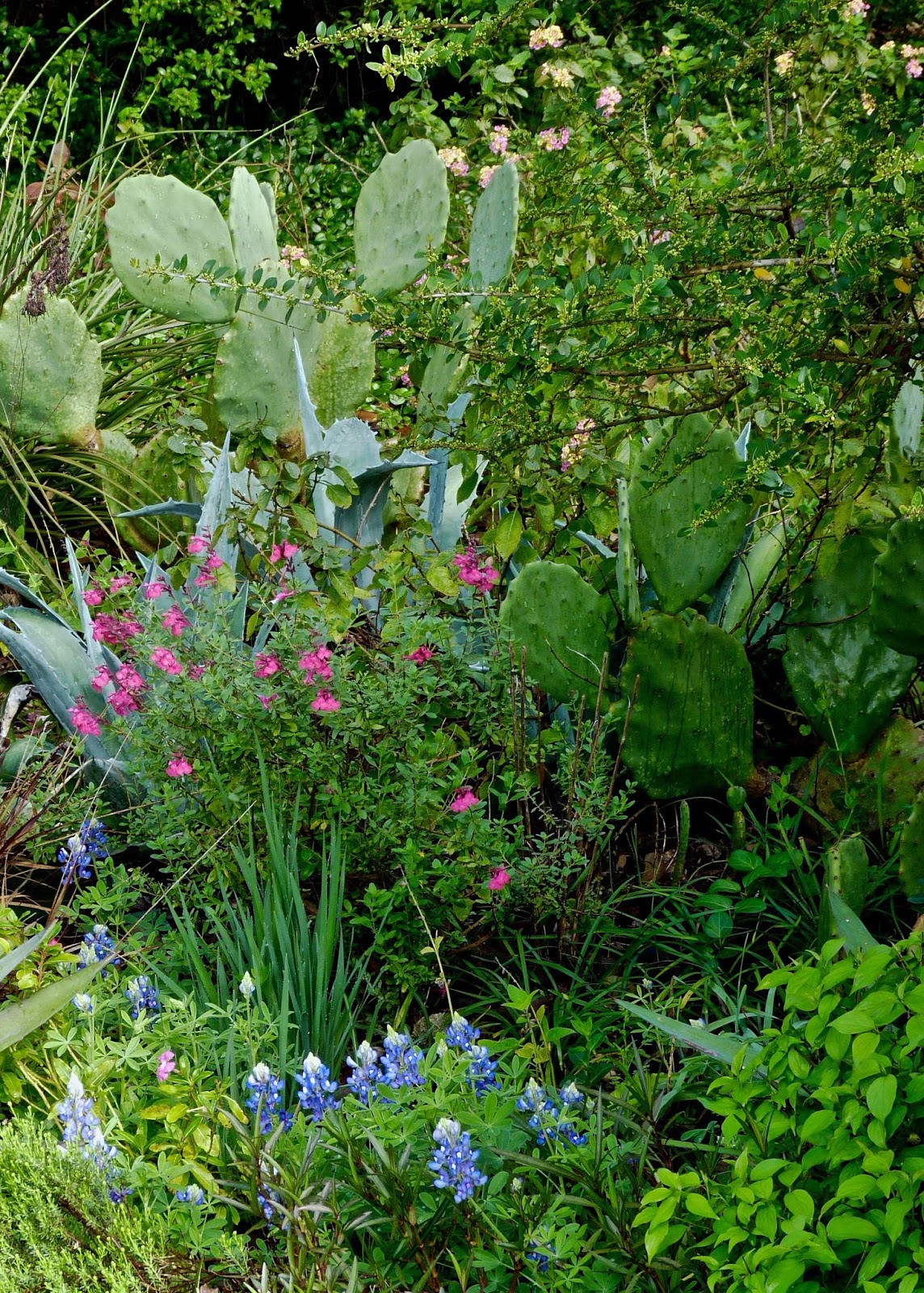
Iconic Spring in Texas.  Painted Lady Butterfly resting on a fallen Live Oak leaf near Bluebonnets.


Not to be outdone, flower spiders are moving in early, establishing their "gotcha!" launch pads, ready for any fly-bys or sap sippers exhibiting more enthusiasm than experience.

Until I was editing this on my computer, I'd missed the spider hiding just behind unopened milkweed buds. Probably exactly the plan, hiding in plain sight.

Area lizards stake out sunny spots.  Posing for potential mates...
Pole dance anyone?
or stretched out impressively, warming bodies chilled by overnight lows.

Local rock star - a Texas spiny lizard
Nests and nesters abound. It is a busy time and procreation is in the cards for the lucky.
Two Carolina wrens spent days getting this nest tucked up right over our main egress to the back deck.  We've switched to a different door for the duration, hoping to disturb as little as possible..
Paper wasps are building everywhere, requiring constant trips to procure needed pulp.  This bench must seem like a real jackpot resource wise.
Leaning in, wasp style.


Weather assisted or assaulted, the persistence of life is in beautiful evidence everywhere.
I thought I'd gotten all this Bristly Mallow out.  Clearly that was an optimistic assessment, but I'll enjoy the flowers for a few more days before going after this aggressive ground cover.

Happy Spring to you!  May all the blooming, nesting, buzzing, chirping days yet to come be filled with joy and beauty, wherever you are.  

Sunday, February 28, 2016

I finally heard it - maybe you have too?

I thought I'd become immune.
I thought I'd gotten
 too hardened,
 frustrated to the point of no return.
But I kept being called out, drawn into the garden spaces.
I pretended to see if I needed to trim something a bit...
but then I'd stop to admire while acknowledging nothing needed trimming.

As I ventured out in my garden beds, I began hearing something.  At first it was barely audible.
But it happened again...and again.
A little snatch of tune...a snippet of melody...just the notes at first.  Until finally...the words became
just 
clear 
enough...to catch.  I had to actively listen, to hear.
To finally admit and understand.
It was only, ever, going to be a matter of time.
Because when it comes to the great awakening of garden and gardener alike? We silly humans may swear we are done, that this gardening thing, it is all over. We can say we have washed our hands and walked away forever.

But the garden, deep in her heart, she simply knows better.
Time, as always, is on her side.

Sings my garden:
Time is on my side, yes it is


Now you all would say, that you wanna be free
But you'll come running back (Like I said you would, baby)
You'll come running back (Like I told ya so many times before)
You'll come running back to me, yeah


You're searchin' for good times, but just wait and see.
You'll come running back (I said you would, darlin')
You'll come running back 
You'll come running back to me


Go ahead, baby, go ahead. Go ahead and light up the town.
Baby, do anything your heart desires remember, I'll always be around
I know, I know like I told ya so many times before
You're gonna come back, yeah you're gonna come back, baby 


'Cause I got the real love the kind that you need
You'll come running back (I knew you would one day)
You'll come running back (Like I told you before)
You'll come running back to me, yeah


Via Wikipedia: "Time Is on My Side" is a song written by Jerry Ragovoy (under the pseudonym of Norman Meade). First recorded by jazz trombonist Kai Winding and his Orchestra in 1963, it was covered (with additional lyrics by Jimmy Norman) by both soul singer Irma Thomas and the Rolling Stones in 1964.
 

Saturday, December 12, 2015

December Wrap Up

I've been neglectful of this space.  Who cares why, and I'm certainly not here to promise it will never happen again.  (I'm pretty sure this post will be standing here, lonely, for weeks yet to come.)

That said, I did want to share a bit of admittedly belated wildlife love for the month, as well as pointing out an unexpected but welcome pop of seasonal native color.

My wildlife appreciation this month does not consist of photographs of creatures, but rather I'm featuring two trees that draw those creatures in, month in and month out. The first is not a native, but it is most certainly a boon to natives.

The Loquat, or Eriobotrya japonica, is originally native to China where cultivars have been developed for over a thousand years.  Varieties were developed for home cultivation featuring flowers that open a few at a time, resulting in prolonged blooming with more gradual fruit development.  I don't know what cultivar we have, but it is certainly not that.

Ours goes all out, with no holds barred.  Bees visit in numbers great enough that on a quiet day you can hear them buzzing two stories up, in the tree's floriferous canopy.  Red Admiral and Question Mark butterflies love these trees.  They visit the flowers now and especially enjoy nectaring off the bounty of fallen fruit to come later.  Actually, the fruit seems to delight every critter around, feathered, furred or winged.  The flowers, though small, give off a lovely scent that reminds me of almonds.

Loquat trees have broad evergreen leaves that provide wonderful shade and protection all year.  The various spiders living in the ground covers below these trees must number in the hundreds. There's a little something for everybody, in Loquat Land.

Another tree, a native this time, one that gives as good as it gets?  The Cherry Laurel, or Prunus caroliniana.  This tree is also evergreen, providing a year round canopy that sports tiny white flowers and then shiny dark fruit that many birds enjoy once dried.

Cherry Laurels are mentioned as being especially beneficial to native bees, and that always makes me happy, too.

Last up?  I wanted to point out a bit of native seasonal color that often escapes notice. Oenothera speciosa, or Pink Evening Primrose is a lovely native wildflower that tends to disappear from view with summertime heat.

Given a little encouragement, the primrose stems pop back up after autumn rains and the resulting foliage responds beautifully to chilly nights. Shown above in a planter in mid November, you can see the tips of the Primrose's elongated leaves turning deep red as they get started on this year's comeback trail.

I've rarely seen it used as a container plant, but I find the color it provides definitely warrants its inclusion.  I find it especially lovely used in combination with succulents.

I'll admit this photo could be confusing - the flower shown is not the primrose itself in bloom but is rather a dianthus in the same planter responding similarly to the more favorable conditions of December.  Evening Primrose won't be flowering until Spring, but those rosy leaves seen behind the Dianthus flower are just as lovely to my eye.

Pink primroses are another native specified as beneficial to native bees, and I'm always relieved and happy to see them coming back into their own once summer's worst is behind us.  Red leaves now, pink blossoms later.  Win/win.

For other wonderful glimpses into the joys and benefits of wildlife gardening, please visit Tina of My Gardener Says for her monthly Wildlife Wednesday roundups.  In the comments section of each post you'll find links to thoughtful and accomplished wildlife gardeners from all around the globe.  There's simply no better way to spend time indoors.  

Thank you all for visiting and reading.  I'd like to extend my heartfelt wishes for a meaningful holiday season, warmly shared with family and friends.  Happy December  - may your days be merry and bright!

Thursday, February 12, 2015

Wait, what month is it again?

February.  It is February.  I had to remind myself of that fact several times over the past few days.

February in Central Texas is not particularly brutal. Often following on the heels of a hard freeze or two in January, February typically provides a fair number of days featuring cold but not freezing weather, in combination with rain.  Cooler days and moist soil make winter work in the garden comparatively pleasant.

Especially for me.  I am an inveterate transplanter.  For my purposes, I need every single typical day February can provide, in order to tackle everything I hope to get done before live oak trees begin their annual pollen assault.
 
I consider transplanting a locational "do-over", a second (or third) chance to get things right.  Some of my favorite plants achieved that designation based upon little more than their repetitive tolerance of my moving them around. It's funny. Once a plant has demonstrated to my satisfaction it will survive a move, I almost always find a reason to move it.

Like the ox-eye daisy mounds shown at the base of the winter bare althea in the photo to follow. They were very recently shifted.  I'm trying out new companion plantings here to provide more year round interest in this bed. The sunny area vacated by the daisy mounds is slated to host native milkweed.

It is a win/win scenario.  Though the success rate of native milkweed seed germination under my care is still in question, the daisy mound moves ought to be a slam dunk. This is February rather than August, so survival ought to be guaranteed.  Right?

Maybe.  This February just refuses to play by the rules.  The past span of days brought sufficient sun and warmth in combination I felt I had to halt rearranging in favor of hauling watering cans.  Walking to and from our rain barrels, I shed layer after layer of clothing as the day and I both heated up.
Relocated wildflowers.  Hang in there babies!
As the weather plays "Guess What Season It Is!?" I'm not the only confused one. Some plants seem to be struggling with how to respond to non-wintery sun warmed soils and bright hot afternoons.  Several bluebonnet rosettes sent up early bloom stalks this year, and at certain times of day, one of them looks practically purple.  
This bluebonnet is definitely blooming to the beat of a different color palette. I'm smitten!
If this plant persists in sending up purplish bloom stalks, I will hold the seed aside and see if the deeper coloring is expressed consistently.  In the meantime, I am throughly enjoying this early start on wildflower season even as I keep an eye out for the colder weather predicted to be heading our way.

Me! Wanting more cold, more grey!  Unprecedented.
Honestly I am only wanting February to be more, well, February-ish.  Hot and dry can wait.  And it ought to! Please?