Welcome!

Welcome to austinagrodolce … My family and I garden with more intention and enthusiasm than allocated budget or overall design plan. It shows. Wildlife populations don't seem to notice our lack of cohesive design, they just like the native plants here. It seems by growing local we've thrown out a welcome mat. Occasionally, we're surprised at who (and what) shows up.


Showing posts with label Bluebonnets. Show all posts

Wednesday, March 25, 2015

Out like a lamb...

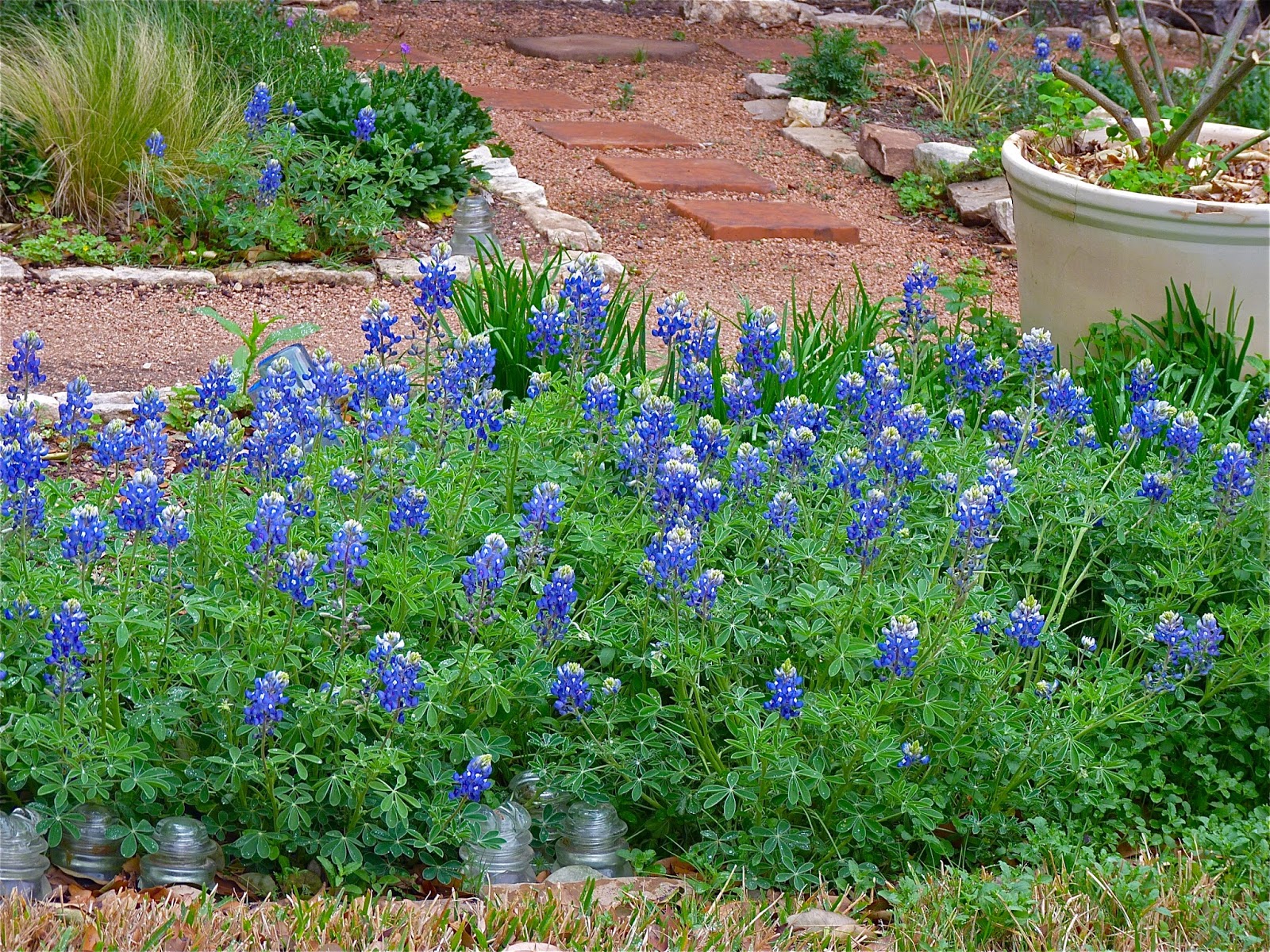
If you regularly read garden blogs originating from Central Texas you are seeing a lot of wonderful photos of bluebonnets and mountain laurels in full bloom. Seasonal rains came at a good time, and folks are understandably smitten with the results.  We Texan gardeners can become a bit giddy over what looks to be a bumper crop of native blossoms. With the reappearance of the Death Star imminent, delicate flowers don't hang around for very long.  We can get a bit carried away.

That said, I am looking at things a bit differently this year, noticing differently, if you will, and this view absolutely took my breath away. Aside from the excitement around seasonal blossoms, to me, this is what the end of March looks like in Central Texas.
Surrounding Live Oaks (Quercus virginiana) adorned with new leaves forming alongside pollen catkins, are dappling every line of sight with the most achingly poignant shade of green imaginable.  They provide an absolutely idyllic backdrop for the reappearance, however brief, of Spring's denizens.
There.  You didn't think I'd let you go without showing you my mountain laurel, did you?  And, just because I can...
OK.  Now we're done.

Thursday, February 12, 2015

Wait, what month is it again?

February.  It is February.  I had to remind myself of that fact several times over the past few days.

February in Central Texas is not particularly brutal. Often following on the heels of a hard freeze or two in January, February typically provides a fair number of days featuring cold but not freezing weather, in combination with rain.  Cooler days and moist soil make winter work in the garden comparatively pleasant.

Especially for me.  I am an inveterate transplanter.  For my purposes, I need every single typical day February can provide, in order to tackle everything I hope to get done before live oak trees begin their annual pollen assault.
 
I consider transplanting a locational "do-over", a second (or third) chance to get things right.  Some of my favorite plants achieved that designation based upon little more than their repetitive tolerance of my moving them around. It's funny. Once a plant has demonstrated to my satisfaction it will survive a move, I almost always find a reason to move it.

Like the ox-eye daisy mounds shown at the base of the winter bare althea in the photo to follow. They were very recently shifted.  I'm trying out new companion plantings here to provide more year round interest in this bed. The sunny area vacated by the daisy mounds is slated to host native milkweed.

It is a win/win scenario.  Though the success rate of native milkweed seed germination under my care is still in question, the daisy mound moves ought to be a slam dunk. This is February rather than August, so survival ought to be guaranteed.  Right?

Maybe.  This February just refuses to play by the rules.  The past span of days brought sufficient sun and warmth in combination I felt I had to halt rearranging in favor of hauling watering cans.  Walking to and from our rain barrels, I shed layer after layer of clothing as the day and I both heated up.
Relocated wildflowers.  Hang in there babies!
As the weather plays "Guess What Season It Is!?" I'm not the only confused one. Some plants seem to be struggling with how to respond to non-wintery sun warmed soils and bright hot afternoons.  Several bluebonnet rosettes sent up early bloom stalks this year, and at certain times of day, one of them looks practically purple.  
This bluebonnet is definitely blooming to the beat of a different color palette. I'm smitten!
If this plant persists in sending up purplish bloom stalks, I will hold the seed aside and see if the deeper coloring is expressed consistently.  In the meantime, I am throughly enjoying this early start on wildflower season even as I keep an eye out for the colder weather predicted to be heading our way.

Me! Wanting more cold, more grey!  Unprecedented.
Honestly I am only wanting February to be more, well, February-ish.  Hot and dry can wait.  And it ought to! Please?

Tuesday, May 20, 2014

Photographic Memory

Going outside with my camera is a more frequent occurrence than going out to weed or water either one.  Bottom line, taking and even editing photographs is simply a lot more enjoyable than hauling watering cans or yanking weeds. Both watering and weeding are important precursors to having anything worth taking photographs of, naturally.  With a sketchy memory like mine, having photographs on hand as reminders of the potential rewards sure comes in handy as motivation.

If one day I am scratching my head and wondering, hmmmm....how long did it take to get from hauling water to baby along the plants shown here...
Bluebonnets! March 10, 2014
past here...

I cut these mature seed pods prior to predicted heavy rain (3 inches!).  May 3, 2014
to here?
Harvested bluebonnet seed futures May 18, 2014
I simply pull up the photos I've taken for the blog and check the dates.  Then when doing that triggers a desire to go back,
March 18, 2014
back,
February 24, 2014
all the way back
February 18, 2014
to see how long it took to get from here...
February 14, 2014
to here?  Rinse, lather, repeat.
April 2, 2014
Occasionally, a before and after set helps remind me of lessons re-learned. Guess what happens when I stubbornly put a cheater pot out front filled with proven delicious-to-deer bloomers?
So pleased with myself for planning ahead, tra la! April 14, 2014
Sigh...Yup.  It might not occur the first night, it might not occur until after two or three nights, but the key takeaway is that The Munching always happens eventually and things ends badly.  For the plants, at least.  I'm supposing the deer was delighted.
I moved the pot out front May 1, 2014.  The morning of May 3rd it looked like this.  Bambi wins again!
Finally, when it comes to jobs that won't, simply can't, last as long as I'd like, such as weeding?  Oh such a thankless job, weeding.  Because I never get ahead, I can never stay ahead.  The seed bank accounts in my garden beds unfortunately represent multiple seasonal deposits.  One withdrawal barely makes a dent.

Rather than reaching for a flamethrower, I find looking at before and after shots encouraging.  A "You've done it once, you can do it again!" approach.  A reminder that these spaces look pretty good, given the chance to shine they way they were originally intended.  Because while this is everything I could hope for in a garden tableau...
April 19, 2014
unfortunately then it morphs into this....
Weedy weedy gone to seedy. May 18, 2014
and takes hours of stoop labor to get it back to this, again.
The reappearance of the ceramic shard mosaic mulch is fussy work but worth it.  The colors underneath the bench function as a reverse shadow all summer long.  May 19, 2014
Are all the weeds in this bed one hundred percent gone?  Ha! Not even close. I'll allow myself a generous accounting of ninety-nine percent gone, and know that if I can get back to this space every week or so for just a few minutes of work, I'll have the summer's worth of joy as my reward. That's a pretty fair trade.  And not if, but when I forget?  The photos will be right here to remind me.

Saturday, May 10, 2014

Happy National Wildflower Week!

I don't have much to add that hasn't already been said about the wisdom of using blooming native plants in your garden spaces.  To my mind, choosing wildflowers is its own reward.
Pink Evening Primrose and Winecup
Pink Evening Primrose seed pods
Purple Prairie Verbena and Pink Evening Primrose
The flowers make everybody happy, bees and birds and butterflies included.

Lemon Bee Balm
Native flowers push up and carry on through drought, and most of them laugh away deer.
Mexican Hat
There's one to survive in just about any microclimate you have on offer.
Yellow Coneflower 
Bluebonnets
Bluebonnet seed pods
As if that weren't enough, many natives either set easily gathered seed or multiply happily in place, creating an opportunity to share passalong plants with your family, friends and neighbors.
Hill Country Rain Lily
Rain Lily seed pods 
The next time you are considering adding a plant to your mix?  Do us all a favor.  Go wild!
Pokeweed
Happy National Wildflower Week everyone!  And Happy Mother's Day!  When you garden, it is no exaggeration to say you are mother to millions.  Here's hoping you will be feted and celebrated as you so richly deserve.

Friday, March 28, 2014

The flowers that bloom in the Spring, tra la!


We've established the annual appearance of Bluebonnets leaves me weak in the knees.   However, human nature being what it is, after the first few weeks of anticipatory breath holding, once the blue blooms kick into high gear, I find myself beginning to cast around, looking for signs that anything else is similarly responding to longer days and warmer temperatures.

And anything else most certainly is.  Specifically, Oenothera speciosa.  The pink evening primrose.

Some say wanting pink primrose in your garden represents a case of needing to be careful of what you wish for.  Massed pink primrose plants can be cantankerous, seemingly wanting to seed in and send runners wherever you don't want them. Left to their own devices they are content to jump out of beds into lawns, paths and planters.  They are much easier to get started than they are to contain or get rid of. They are sometimes considered invasive by those with more orderly tendencies.

Aloe bloom stalk rising above massed Primrose blooms-to-be.
Also under cover, at the base of this stake, a Bulbine struggles to reemerge while this tiny anole observes.
Orderly?  Not me.  What strikes others as invasions appears to me as natives simply doing what they do best.  Given their tolerance for heat and drought I welcome these persistent ladies wherever they may roam.
After all, despite their boisterous tendencies to elbow competitors aside, the pink primrose is a boon to native bees and other pollinators.  Past that, I am and always have been deeply smitten with their blooms.

Because oh!  Those flowers....I've sought them out and loved them since I was a child.  Each one only lasts 24 hours. If it weren't for the oak poison pollen so abundantly in the air I'd be out as many of those hours as I had the light, watching their pink skirts swaying delicately in the breeze.


Tuesday, March 25, 2014

Widely regarded

I'll be frank.  Except for the occasional blog header, I've hesitated when it comes to posting wide shots here.  As opposed to a carefully cropped closeup, wide shots are painfully revelatory.

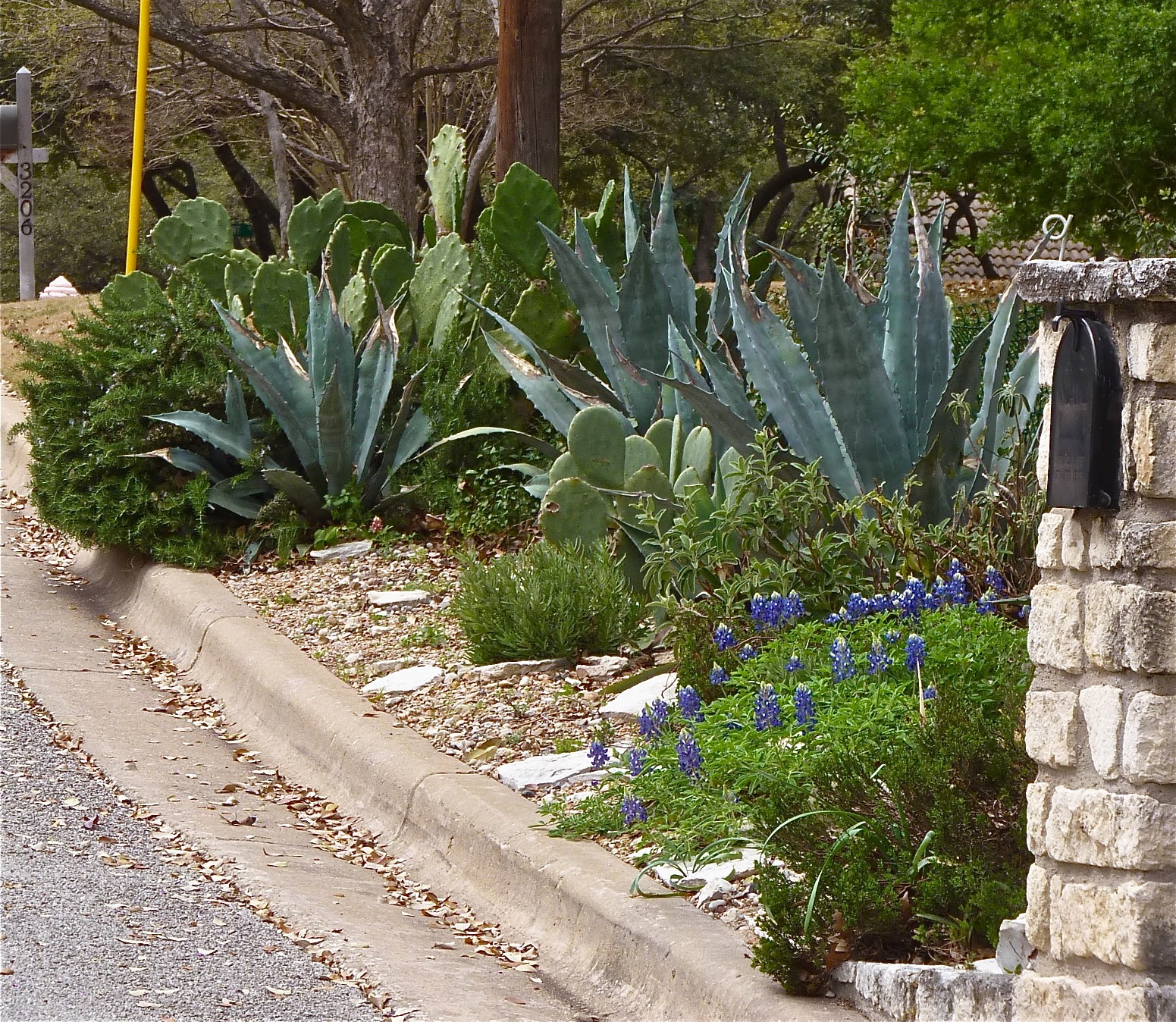
In the spirit of full disclosure and determined to face down this reluctance, today I submit some shots of the front bed, along the curb on the uphill side of the drive.
I may be stating the painfully obvious, but I hadn't planned much in terms of an overall design for the view along the front.  I did have two goals.  The first was to remove all the St. Augustine lawn, and the second was to introduce more variety to areas that were overrun with a combination of two ground covers, Asian jasmine (Trachelospermum asiaticum) and Periwinkle (Vinca minor).

Within a strictly limited budget I began to work towards my goals. As a starting point I figured to use my own labor and a combination of self propagated and passalong plants.  Progress was slow but steady.

One of the two houses across the street from us sold.  After sitting empty for a few months it was completely demolished and then rebuilt from the foundation up.  The resulting noise and chaos drove the decision for our other neighbors across the street to put their house on the market as well.  After it sold the new owners stripped it to the walls and remodeled, top to bottom.

This meant for the better part of the past three years our side of the street has served as a construction zone parking strip, hosting an ongoing parade of pickups, semis and panel vans.

When it came to looking at our spaces from the street I was reduced to intermittent glimpses of the curbside beds when a few of the workers' trucks left at lunch.  Except for Sundays, I rarely had street access to the front beds, and a wall of thorny agaves hampered my approach from the house side. I threw in the trowel, rationalizing with that constant screen of vehicles in place, what nobody could ever see would never hurt me.

Weeks turned to months turned to years.  It didn't rain, it got really hot.  It didn't rain, it got really cold.   Visualize a montage of flipping calendar pages. Fast forward to the here and now.

Both house renovation projects across the street are complete. Without the constant presence of parked vehicles I face, along with the world, the full consequences of our devastating weather and my ongoing neglect.  Big picture?  Well.  It ain't pretty.


To varying extent, every one of the agave plants were damaged this winter. Two coveted narrow leafed green varieties (weberii? americana? they were passalongs in a box and if I was told I can't remember!) were reduced to mostly mush. The centers seem intact.  I trimmed away the rot and am fervently hoping they'll bounce back.

There are a few bright spots.  The sumac I transplanted and protected with a barrier seems to have survived the winter.  Branches are showing signs of terminal budding.  Other plants put in last Fall (salvias, marjoram, penstemons, grasses, ferns, mallows) wintered over with no discernible damage. Many died back to the ground but that is to be expected and they should show signs of regrowth as the temperatures rise.

After agonizing over placement I finally planted two recently purchased gopher plants (euphorbia rigida).  I put them where they'll enjoy good drainage in combination with what I hope is enough sun.   If I guessed correctly they will become well established and not only thrive but reseed.  If I can believe everything I've read, the gopher plants should fill in an approximately 2x3 foot space.  They reportedly survive extremes of heat and cold, drought and deer.  Go go gophers!
Gopher the First (center).  Hoping this will stretch out to eventually reach the curb.
Gopher the Second.  I was originally going to pot this up but instead filled a gap created by the removal of a large cold damaged agave.  
Then there are the bluebonnets.  Last October I tossed out a couple of spent plants with their seed pods still attached.  More intentionally I then spread seed for both white and maroon blooming varieties that, legends aside, were released by the mad horticulturists at Texas A and M.  So far there are a few blooms on each which I hustle to share with you before the deer decide they are deliciously different.


The "maroon" and "white" varieties will never replace their original blue cousins in my heart, but for now I'm enjoying the novelty.  I hear they revert to their original blue within a generation or two but the pops of unexpected color are fun while they last.

Oak pollen will drive me indoors for the next span of weeks.  Regardless, now that I at long last have unlimited access, the urge to address issues out front will find me stubbornly popping outdoors for brief spurts of work.  Several clumps of purple fountain grass were killed by the cold.  I'd like to find native replacements. I want to relieve overcrowding and take out damaged agaves battered by cold and deer.  I will hand water wildflowers if the rains don't come, and there is always work to be done pulling Bermuda grass and replenishing gravel.

And, just perhaps, taking a few more wide shots.  It will be good to regard the curbside area taken as a whole as I continue planning for the future.
Not perfect, no, but much much better than grass!
The good, the bad, and oh my yes, the ugly. Out front I've sure enough got it all.