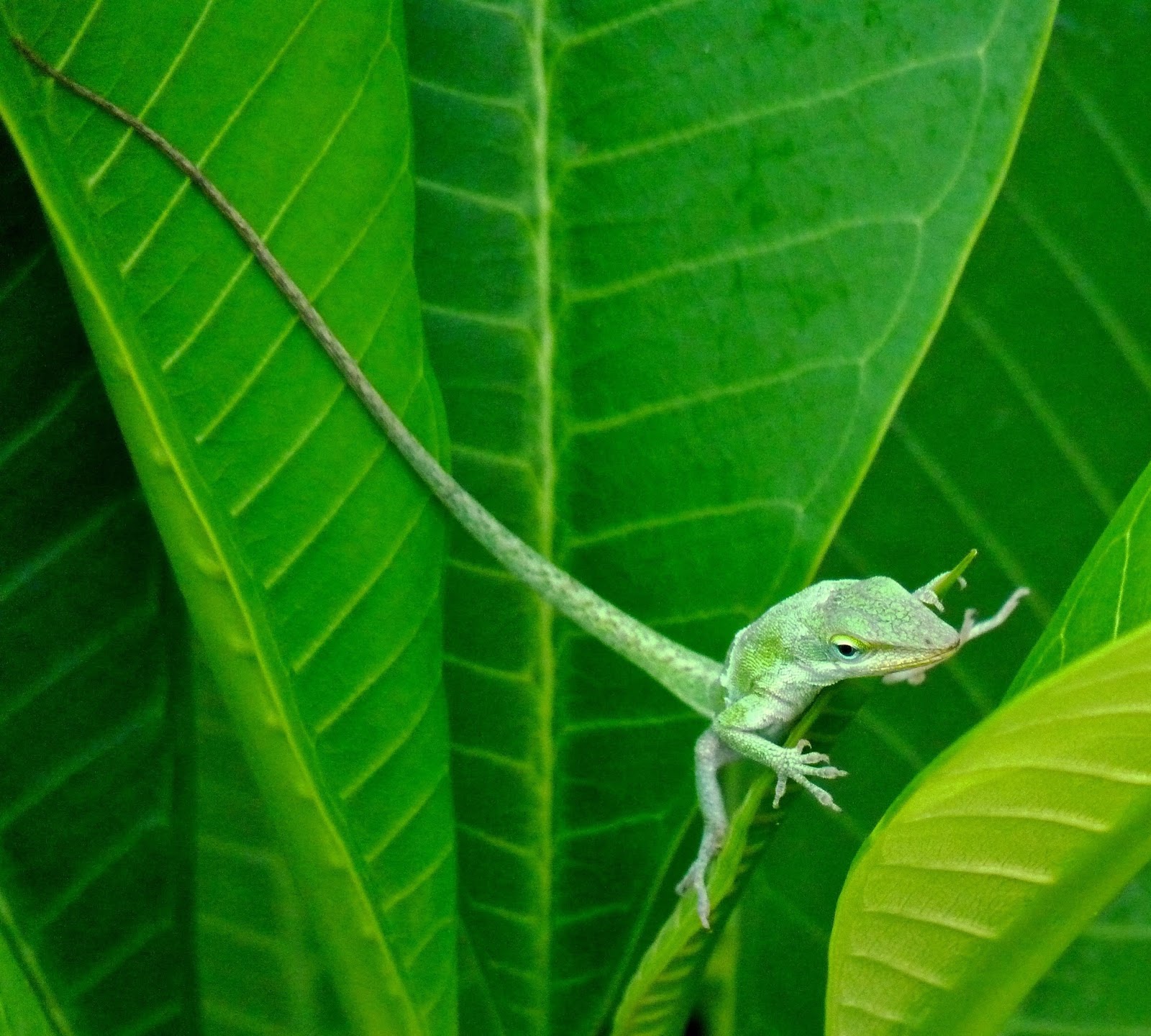
Because it is past the halfway mark for August...
Because others have already blogged about the few things that are in bloom for us this time of year...
And because I didn't even have to go back for a few weeks to cull out the best shots...
I only had to go outside with my camera and pay attention this morning.
This guy was out sipping up what remains of water droplets from last night's watering.
Anoles are everywhere these days and nobody could ask for a more appealing companion in the garden.
This last anole almost completely escaped my attention. Well camouflaged and all snugged up tight against the pole to the left of the butterfly, he seems to be waiting for a little privacy to make his move.
Or maybe it is just too hot to do anything more than look. Here's to the winding down of August and to the easing off of Summer's worst heat. Home stretch, people!
Welcome!
Welcome to austinagrodolce … My family and I garden with more intention and enthusiasm than allocated budget or overall design plan. It shows. Wildlife populations don't seem to notice our lack of cohesive design, they just like the native plants here. It seems by growing local we've thrown out a welcome mat. Occasionally, we're surprised at who (and what) shows up.
Showing posts with label Anole. Show all posts
Tuesday, August 18, 2015
Monday, May 18, 2015
Bug nuts
It has been raining here, quite a lot, in amounts unusual even for May in Central Texas. The good news is the oak pollen is not only off the trees, but has been washed away well out of breathing range for those of us sensitive to its grainy gifts. The not as good news is, with all this rain, the garden has been too soggy for me to knock all the leftover chores off my list. There is one job I have not neglected, rain or shine. Pest patrols simply will not wait for good weather.
It is caterpillar season, and though I gave up trying to properly identify most of what I found creep-crawling around the garden in between rain showers, I feel certain each of these caterpillars knows just what to do, what to eat, and exactly what it is shaping up to become.
In one of those contradictions that seems to define my gardening efforts, though I keep parsley and fennel around precisely so they can be eaten by the caterpillars of moths and butterflies I admire, I was not at all satisfied with leaving certain other larvae alone to decimate their targeted plant hosts.
An infestation of Colorado Potato Beetle larvae was alarmingly sudden, but fortunately close enough to the house to trigger my awareness and ongoing response. Once I realized the numbers I was dealing with, the soapy bath of death came into play, and I am optimistic I put a significant dent in this large but very localized population. I don't grow potatoes, but have been known to toss a sprouted tuber into the ground covers out back for the occasional flowers they provide. I'm not sure if one of those vines pulled these bad players into our beds, but lesson learned. I won't be so careless with future spud rejects - they will all go straight into the compost bin.
In larval form, I found their lumbering shapes and varying sizes, each representing a differently timed batch of hatched eggs, to be oddly appealing. The damage they cause is not appealing at all however, so I made repeat visits back to the area where they first appeared until I couldn't find a single one of any size. I'm pretty sure I'll reflexively check for them everywhere until the shock of their showing up by the dozens fades.
Another unwelcome (though admittedly attractive) visitor is this Aztec Spur-throated Grasshopper, first instar stage. When they are this tiny I try to catch and squish, but they are lightning fast and this little guy escaped to eat another day. Seeing him I know there will be more, many more, so grasshopper patrols have been duly reinstated for the season.
A new (to me) visitor recently was this master of mimicry. A Large Maple Spanworm Moth took refuge on the tiles close to our front door. I was out sweeping leaves away from the house and it would be hard to say who was more startled. Me, when the leaf I was sweeping literally flew across the porch, or this nocturnal moth, who figured it had secured a good spot to wait out the return of night.
Pretty good camouflage. Once I saw it fly I could easily tell it apart from the oak leaves, but up until then it completely escaped my notice.
Of course if I'm going to feature creatures that blend in, there's no escaping including these photo bombers.
Nobody here but us heartleaf skullcap leaves, boss.
Begging your indulgence, I must include what is for me an obligatory Honeybee on Opuntia blossom shot. Rain or shine, the flowers on the spineless opuntia are putting on quite the show this year. Given any reasonable break in the cloud cover, the bees are quick to take advantage.
And who could blame them? I find even the tightly wrapped buds attractive.
Finally, the Poppa and Momma mockingbird who set up shop across the street have successfully fledged at least one baby this year. They have relaxed just a little, finally allowing most regular street traffic to pass unmolested.
There is one particular male squirrel that seemed to take pleasure in being chased, going out repeatedly and keeping a fairly precise distance ahead of his pursuers. Days of rain seem to have interrupted the antics, but I have a feeling this bird and that squirrel have formed a chase challenge bond that will be playing out all summer long.
The mockingbird and I, we are keeping a close eye out for trouble makers of all sorts. Vigilance, that's the key.
It is caterpillar season, and though I gave up trying to properly identify most of what I found creep-crawling around the garden in between rain showers, I feel certain each of these caterpillars knows just what to do, what to eat, and exactly what it is shaping up to become.
| Chevron Striped Whatchamacallit |
| TeeWeeny Tiny Yellow Thingie |
| Sphinx Moth Cat on Fennel |
An infestation of Colorado Potato Beetle larvae was alarmingly sudden, but fortunately close enough to the house to trigger my awareness and ongoing response. Once I realized the numbers I was dealing with, the soapy bath of death came into play, and I am optimistic I put a significant dent in this large but very localized population. I don't grow potatoes, but have been known to toss a sprouted tuber into the ground covers out back for the occasional flowers they provide. I'm not sure if one of those vines pulled these bad players into our beds, but lesson learned. I won't be so careless with future spud rejects - they will all go straight into the compost bin.
| Colorado Potato Beetle Larvae - two different hatches |
Another unwelcome (though admittedly attractive) visitor is this Aztec Spur-throated Grasshopper, first instar stage. When they are this tiny I try to catch and squish, but they are lightning fast and this little guy escaped to eat another day. Seeing him I know there will be more, many more, so grasshopper patrols have been duly reinstated for the season.
A new (to me) visitor recently was this master of mimicry. A Large Maple Spanworm Moth took refuge on the tiles close to our front door. I was out sweeping leaves away from the house and it would be hard to say who was more startled. Me, when the leaf I was sweeping literally flew across the porch, or this nocturnal moth, who figured it had secured a good spot to wait out the return of night.
Pretty good camouflage. Once I saw it fly I could easily tell it apart from the oak leaves, but up until then it completely escaped my notice.
Of course if I'm going to feature creatures that blend in, there's no escaping including these photo bombers.
Nobody here but us heartleaf skullcap leaves, boss.
Begging your indulgence, I must include what is for me an obligatory Honeybee on Opuntia blossom shot. Rain or shine, the flowers on the spineless opuntia are putting on quite the show this year. Given any reasonable break in the cloud cover, the bees are quick to take advantage.
And who could blame them? I find even the tightly wrapped buds attractive.
Finally, the Poppa and Momma mockingbird who set up shop across the street have successfully fledged at least one baby this year. They have relaxed just a little, finally allowing most regular street traffic to pass unmolested.
There is one particular male squirrel that seemed to take pleasure in being chased, going out repeatedly and keeping a fairly precise distance ahead of his pursuers. Days of rain seem to have interrupted the antics, but I have a feeling this bird and that squirrel have formed a chase challenge bond that will be playing out all summer long.
The mockingbird and I, we are keeping a close eye out for trouble makers of all sorts. Vigilance, that's the key.
Tuesday, April 7, 2015
April's Timetable - Texas in Bloom
By the time it is mid April in Texas, most questions surrounding Wildflowers:Will They or Won't They? have been answered for another year, and it is all over but the bluebonnet trampling, as folks scramble to take photos surrounded by all that heavenly blue.
Though the majority of my bluebonnets bloomed early, I have a few other native specimens that seem to be taking an opposite tack. These perennial procrastinators are still cruising along, content to remain on Bloom Watch status.
Case in point - Bauhinia, or Anacacho orchids are in full bloom around town, including on the University of Texas campus where several gorgeous specimens are providing beauty over by the Art buildings. On the tree growing in our significantly more shaded setting however, the buds are just beginning to appear.
Same goes for what I believe to be a small stand of Roughleaf dogwood (Cornus drummondii) also growing here in deep shade. Unlike photos of specimens growing in more sunny open areas, our dogwoods sport eensy white flowers I find nearly impossible to capture in a photograph. Even showing you the buds proved tricky as April breezes seem to somehow be attached to, or, triggered by the presence of my camera. Every time I pick the one up, the other picks up as well.
An onion that decided to sprout last summer morphed in a very few days from pantry staple to garden candidate. After planting, the stalk hung around aimlessly for months but the payoff is finally on the horizon. When it comes to alliums I like their flowers in the garden almost as much as I enjoy eating the parts I routinely slice or saute for dinner.
Speaking of eating, several culinary sages I planted a couple of years ago to use in the kitchen (Salvia officinalis) sent up bloom stalks for the first time this year. I had no idea these plants flowered and clipped a few stems to try and prolong the plant's usefulness as an herb. Looking at the shape and color of the stem and blooms their kinship to other salvias is obvious.
Blogger Debra from Under the Pecan Leaves recently featured some wonderful shots of tiny white waxy flowers appearing on a more mature native persimmon tree she put in after beginning to grow persimmon seedlings. Her post reminded me I'd noticed a persimmon here for the first time last season (Diospyros texana), surprised originally by the fruit and then by the attention lavished upon said fruit by a territorial mockingbird.
I checked for flowers now that I knew to look, and despite the lingering presence of maturing fruit on the tree, sure enough there they were. Blink-and-you'll-miss-them small, yet packed with promise.
Besides blossoms, tiny galls indicate some symbiotic insect or organism has been busy working nearby. It makes for some alarmingly tortuous looking leaves, but is nothing that will harm the tree long term.
I've heard galls compared to bug bites on humans. Irritating but rarely significant. By the time you notice the bite, the culprit is long gone. I'm choosing to interpret this activity as a positive reminder that growing native flora supports the life cycles of multiple interdependent fauna.
Native plant whisperer and garden blogger Tina, from My Gardener Says, generously shared several salvia lyrata plants after I went all fan girl crush on hers last year. I'd been concerned to show their progress here previously, unsure I'd planted them in spots where they would flourish, but several bloom stalks later and I'm happy to be enjoying these blossoms in person at last.
With their deeply colored veining, I'm seeing lyreleaf sage as a great native substitute for what is an old Austin landscaping and garden standby, Ajuga.
The sage grows a bit taller, and with only a handful in play currently I'm not pulling out my ajuga plants just yet. I do hold high hopes for the salvia lyrata to seed out and produce a dense stand of sage to eventually be used in ajuga's stead. Or maybe in combination? I have a very hard time pulling out happy plants, even when they aren't native.
Finally, while you may be weary beyond measure of the constant stream of anole photos featured here, I should warn you I am only getting started. I don't think I ever spotted an anole I didn't try to photograph. They pose so adorably - resistance is futile.
Happy Trails!
Though the majority of my bluebonnets bloomed early, I have a few other native specimens that seem to be taking an opposite tack. These perennial procrastinators are still cruising along, content to remain on Bloom Watch status.
Case in point - Bauhinia, or Anacacho orchids are in full bloom around town, including on the University of Texas campus where several gorgeous specimens are providing beauty over by the Art buildings. On the tree growing in our significantly more shaded setting however, the buds are just beginning to appear.
| Orchid flowers on the way |
| These dogwood multiply via suckers. We are slowly getting a small thicket of them. |
| Compost bin or garden bed? Once onions sprout, they can swing either way. |
| I thought about sprinkling these on a salad but put them in my kitchen window instead. |
I checked for flowers now that I knew to look, and despite the lingering presence of maturing fruit on the tree, sure enough there they were. Blink-and-you'll-miss-them small, yet packed with promise.
Besides blossoms, tiny galls indicate some symbiotic insect or organism has been busy working nearby. It makes for some alarmingly tortuous looking leaves, but is nothing that will harm the tree long term.
I've heard galls compared to bug bites on humans. Irritating but rarely significant. By the time you notice the bite, the culprit is long gone. I'm choosing to interpret this activity as a positive reminder that growing native flora supports the life cycles of multiple interdependent fauna.
Native plant whisperer and garden blogger Tina, from My Gardener Says, generously shared several salvia lyrata plants after I went all fan girl crush on hers last year. I'd been concerned to show their progress here previously, unsure I'd planted them in spots where they would flourish, but several bloom stalks later and I'm happy to be enjoying these blossoms in person at last.
With their deeply colored veining, I'm seeing lyreleaf sage as a great native substitute for what is an old Austin landscaping and garden standby, Ajuga.
The sage grows a bit taller, and with only a handful in play currently I'm not pulling out my ajuga plants just yet. I do hold high hopes for the salvia lyrata to seed out and produce a dense stand of sage to eventually be used in ajuga's stead. Or maybe in combination? I have a very hard time pulling out happy plants, even when they aren't native.
Finally, while you may be weary beyond measure of the constant stream of anole photos featured here, I should warn you I am only getting started. I don't think I ever spotted an anole I didn't try to photograph. They pose so adorably - resistance is futile.
Happy Trails!
Friday, March 20, 2015
Beginnings...
Garden ball Gazing Guy and I both want to wish everyone a very sweet First Day of Spring.
At least, if you live in this Hemisphere... If not, stay warm and know that as soon as we are finished with it and clean up after? We'll be sending Spring right back to your side of the globe/s.
Wednesday, November 5, 2014
Wildlife Wednesday November 2014
I was walking back from the mailbox with both hands full when I spotted something that looked like a green sash hanging from the belt of St. Francis. I took the mail inside, picked up my camera, and went back for a closer look. This is what we had going on.
An anole, soaking up radiant late afternoon sun against the mass of St. Francis' robes. Warmth from above and below. Mmmm. Toasty.
November brings reminders that actual Winter, in whatever form it will assume here this year, is well on the way. Plants and animals are moving a little more slowly and many are facing weeks of dormancy.
Gather ye sunbeams whilst ye may, little green guy. This year's party is nearly over.
............................................................................................
This is my November contribution to Wildlife Wednesday. A once-every-month opportunity on the first Wednesday, to celebrate and appreciate the creatures that populate our outdoor spaces. My ongoing appreciation to Tina at My Gardener Says for creating and hosting.
Want to join the fun? It's easy-peasy. Simply post about your wildlife (it can be informational or entertaining or both!), then place a link to your post in a comment on Tina's blog post for the meme for that month and that's all it takes. Happy November to all - hoping yours will be "wild" in the best possible way.
Labels:
Anole,
Fauna,
November,
St. Francis,
Wildlife Wednesday
Wednesday, July 2, 2014
Learning to Expect the Unexpected
It is not often you have the honor to be present for and part of the Very First anything, so I am tickled all shades of pink to be here for The Very First Ever Wildlife Wednesday, hostessed by Tina at My Gardener Says. Or perhaps I should say all tickled all shades of green...
I've posted here several times in the past about the anoles that are regularly observed in our outdoor spaces. I've always thought they were very cool, and in another example of a Very First, the green anole, more scientifically referred to as Anolis carolinensis, recently became the first reptile to have its genome completely sequenced.
I think they look like little dinosaurs, and everybody in our household regularly enjoys watching them posture, either to attract females,
or as in this case, to intimidate a potential predator.
Anoles don't always show up when or where you'd expect to see them. Or at least, not where I expect them. I came across this guy surfing the waves of the rosemary out front.
Looks like he's molting doesn't it? I'd read anoles molt regularly but I'd never seen one in process before.
As far as what I did expect, I placed a purple and orange birdhouse on our fence close to where a Grandpa Ott Morning Glory vine was growing. Initially, I was totally expecting to see this:
and with any luck, eventually flowers blooming close to the orange roof like this:
Wait a second! I had to take a closer look because I was certainly not expecting to see this:
Honestly if I saw an anole posed just so in a painting I'd never ever believe it came from life. I'd be certain it was a case of an artist really letting their imagination run wild. Because come on, a purple flower blooming right next to the orange roof with an anole juxtaposed provocatively just behind it? Naaah. That's a step too far, right? Never happen in a million years.
Except that it did, and by a stroke of sheer right-place-at-the-right-time good fortune, I was there to catch it.
The anole seemed irritated by my presence (though they all always look slightly annoyed to me) so still shaking my head in disbelief I quietly moved off and left him (her?) to whatever business it was conducting there on the fence.
Always welcome, and occasionally? A completely unexpected sight. Anoles!
A round of applause to Tina for not only proposing, but hostessing Wildlife Wednesday on the first Wednesday of each month. Our gardens are not only about the plant life we tend to but are equally about the wildlife we attend to. I'm happy to be here and sure hope you'll join in!
I've posted here several times in the past about the anoles that are regularly observed in our outdoor spaces. I've always thought they were very cool, and in another example of a Very First, the green anole, more scientifically referred to as Anolis carolinensis, recently became the first reptile to have its genome completely sequenced.
I think they look like little dinosaurs, and everybody in our household regularly enjoys watching them posture, either to attract females,
or as in this case, to intimidate a potential predator.
Anoles don't always show up when or where you'd expect to see them. Or at least, not where I expect them. I came across this guy surfing the waves of the rosemary out front.
Looks like he's molting doesn't it? I'd read anoles molt regularly but I'd never seen one in process before.
As far as what I did expect, I placed a purple and orange birdhouse on our fence close to where a Grandpa Ott Morning Glory vine was growing. Initially, I was totally expecting to see this:
and with any luck, eventually flowers blooming close to the orange roof like this:
Wait a second! I had to take a closer look because I was certainly not expecting to see this:
Honestly if I saw an anole posed just so in a painting I'd never ever believe it came from life. I'd be certain it was a case of an artist really letting their imagination run wild. Because come on, a purple flower blooming right next to the orange roof with an anole juxtaposed provocatively just behind it? Naaah. That's a step too far, right? Never happen in a million years.
Except that it did, and by a stroke of sheer right-place-at-the-right-time good fortune, I was there to catch it.
The anole seemed irritated by my presence (though they all always look slightly annoyed to me) so still shaking my head in disbelief I quietly moved off and left him (her?) to whatever business it was conducting there on the fence.
Always welcome, and occasionally? A completely unexpected sight. Anoles!
A round of applause to Tina for not only proposing, but hostessing Wildlife Wednesday on the first Wednesday of each month. Our gardens are not only about the plant life we tend to but are equally about the wildlife we attend to. I'm happy to be here and sure hope you'll join in!
Monday, April 21, 2014
Apropos of April
I never seem to get organized in time to participate in variously occurring "days" where garden bloggers show off what is blooming at regular intervals (or in other cases, what their foliage stars are up to). I applaud those who do so. I openly admit that sort of advance planning is not one of my strengths.
Regardless, there is a lot going on in our spaces this time of year. At the risk of being designated a "petal pusher" (I'm looking at you, DC!) and apropos of nothing more than April itself? Here's what's been grabbing most of the local attention lately.
| This Grass Spider (Agelenidae) is apparently suffering from an identity crisis as it spent all day posing on the pink evening primrose (Oenothera speciosa). |
| Coral honeysuckle (Lonicera sempervirens) has rewarded me for cutting back overhanging branches with an abundance of scarlet trumpets. |
![]() |
| Yellow Coneflower (Ratibida pinnata - I think) glows in the morning sun. |
| Another singer in the local oaks - a black crested titmouse (Baeolophus atricristatus) |
![]() |
| A consistent favorite of local gardeners and birds alike - Possumhaw Holly (Ilex decidua). |
| It can look pretty sketchy off season, but it is hard to beat Damianita Chrysactinia mexicana) in bloom. |
![]() |
| I wish these two were more seasonally synchronized, but at least I've got one "late" bluebonnet playing nicely with an "early" Salvia coccinea. |
![]() |
| Mexican honeysuckle (Justicia specigera) growing in between paddles of Opuntia ellisiana. |
![]() |
| The delicate bloom stalk of Provence Lavender (Lavandula Intermedia which grows well here in Texas), highlighted against a backdrop of Damianita. |
![]() |
| With a promise of blooms to come, Opuntia ellisiana, or spineless prickly pear, is setting out rows of buds. |
Subscribe to:
Posts (Atom)