Welcome!

Welcome to austinagrodolce … My family and I garden with more intention and enthusiasm than allocated budget or overall design plan. It shows. Wildlife populations don't seem to notice our lack of cohesive design, they just like the native plants here. It seems by growing local we've thrown out a welcome mat. Occasionally, we're surprised at who (and what) shows up.


Showing posts with label Native plants. Show all posts

Wednesday, November 4, 2015

November Wildlife Wednesday - October's Bag of Treats

We talk a lot about the weather here in Texas.  A LOT.  On the face of it, the weather is at least a topic less contentious or divisive than politics or religion. Additionally, as subject matter it is a bottomless well of content, for as the old saying goes "If you don't like the weather in Texas, wait five minutes and it will change.".

And at no time is that more apparent in Texas than in October.  One day will be hot and dry, the next day cool and cloudy, periods of drought are often followed by torrential rains and all within the span of one brief month.

Thought of as the beginning of a "second Spring" in gardening circles, October is a turning point, a pivot between endless heat and the cooling to come. October provides easier growing conditions and last minute growth spurts along with pleasant working conditions for gardening chores.  For wildlife, October is a time to eat, to reproduce, a time to migrate, or just to hunker down.

The visitors here in the hills just west and south of Austin last month were mostly of the winged variety, though a few walked in.  Daily in October, unless it is pouring rain, wrens fuss-fuss-fuss, cardinals tick, jays shriek, and mockingbirds guard "their" berry sources.  Everything seems to enjoy the final loosing of Summertime's hot dry grasp.

Berry eating locals were well represented by Northern Mockingbirds. Here one is shown making an afternoon feast off of Rivina humilis, or Pidgeonberry plant.
This bird was hopping up off the ground repeatedly in a neat maneuver designed to snatch a single berry at a time off the top branches of this low growing plant.  Try as I might I was not able to catch the bird in mid-hop.  (I may or may not have taken and discarded upwards of 40 shots, ahem!).

Other winged creatures were appreciated as they flittered, fluttered and fed. A rare sight here, this black and yellow lichen moth (Lycomorpha pholus), was nectaring on mint. And yes, black and yellow does seem to be a misnomer, but in the face of such an attractive creature, why waste time quibbling?
That protective coloration had me thinking this was some other more pestilent variety of visitor at the start.  After a careful capture and subsequent identification effort, I was relieved I didn't try to eliminate this slow growing and thematically appropriate October drop in.

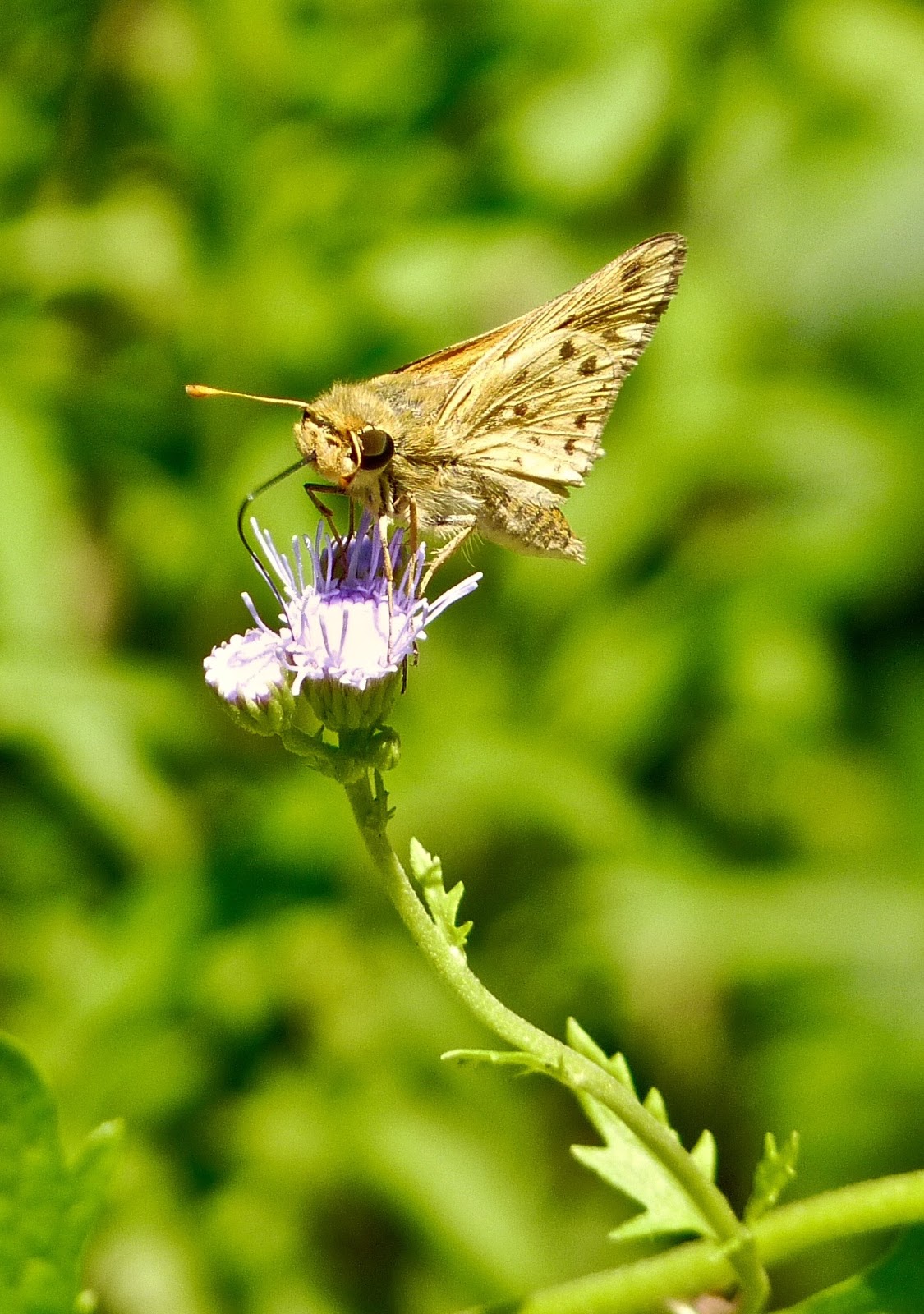
More common visitors appeared to keep us company while outdoor October chores were tackled.  Skipper butterflies were most numerous, as has become usual for our spaces.  In October we saw (and as with all Skipper identifications - these are only best guesses!) various Duskywing Skippers...
and a host of Fiery Skippers as well.
We were at long last graced by royalty, with one documented visit by a Queen Butterfly, (Danaus gilippus) and even one single Monarch, though I was not able to get a reasonable photo of that migratory wonder.
No less lovely for their small size or protective coloration, the presence of many adult lacewings is the logical result of various aphid infestations.  Aphids having provided a steady food source for their larvae earlier this year, it was rare to prune or move aside a branch in October without dislodging one or more of these lacey beauties.
Not quite so tiny but just as beneficial, paper wasps, Polistes exclamans, continued their ongoing hunt for caterpillars of all sorts to feed their young at the nest.
Shhhh - naptime in the nursery....

Gangly and apparently caught between coloration decisions, this Walking Stick (Phasmatodea) displayed the typical head bobbing designed to help it visually scan its surroundings for threats or snacks.
Finding neither on our deck door screen, this insect entertained our two indoor cats for the span of a half hour or so then abruptly disappeared.

The most fascinating saga for October had to be the appearance of two Manduca Sexta or tobacco hornworm caterpillars, feeding on a large Datura plant right off the front porch.
Tobacco hornworms are differentiated from the visually similar tomato hornworm by their seven white stripes, linear (like cigarettes).  The tomato hornworms have eight V shaped markings (think "V" for vine-ripened).  These caterpillars are able to successfully consume various toxins that they mostly excrete in droppings.

That said, it was hard to imagine they could consume such a toxic plant without experiencing any of the hallucinogenic effects.   Especially this one that took on the task of chowing down on a seed pod.
These caterpillars are able to sequester and release certain amounts of the toxins they consume via respiration, a form of "toxic halitosis" that is thought to deter spider attack.  They reportedly also click their mouthparts when attacked.

I'll take those reports on good faith.  Any caterpillar able to consume two long branches' worth of Datura leaves and the occasional seedpod is best left to conduct its own business undisturbed.

And that about wraps up this month's catalogue of visitors here at austinagrodolce.  Perhaps not an exhaustive list, but certainly representative of the majority of the usual suspects.

Our use of native plants in combination with attempts to avoid chemicals and allow a natural balance between predators and prey to evolve here have rewarded us with both an ever increasing variety and number of wild visitors to enjoy.  They are all quite pleasant company to keep as we work to ready the garden for whatever-comes-next.  We garden for them, they work in the garden with us, it is all pretty much sweetness and light in this most pleasant of times.

Thanks as always to Tina of My Gardener Says for hosting the Wildlife Wednesday meme each month.  Do take time to check out her always informative and entertaining chronicle of gardening with natives.   While there, be sure to link to your own Wildlife Wednesday post in the comments section of her November Wildlife Wednesday offering to share with wildlife lovers world wide.  We'll all be glad you did!


Thursday, August 27, 2015

Anticipation

This mature Datura (Datura wrightii/Sacred thorn-apple) planted close to our front door has been showing off this summer, demonstrating why it is allowed to dominate the area where it grows.
For several weeks it had been developing a record number of buds, each one reminding me a bit of okra pods.  We watched the pods get larger, and eventually a few began to unfurl each day.  Then, record numbers of the pods matured at once, and for two evenings in a row this one plant has treated us to an even dozen blossoms, all opening at one time.
Previously I'd tried in vain to appreciate the widely reported fragrance of the blossoms. Now I can smell them!
The bees have been taking advantage of the fact these blooms, shaded by the house, aren't exposed to direct light until the sun is high in the sky.
The flowers stay open all morning and drew the bees in droves earlier today.
I spotted multiple types, European honeybees and native bees alike.
We were all happy-happy.
Datura is a native, and the speed with which the one-day-and-done flowers draw pollinators in is testimony to a long-standing and well evolved relationship.  I've not had luck starting these plants from seed, but nursery stock is readily available year 'round, with spring planting recommended for more reliable success.

I have two smaller Datura plants out closer to the street, but they aren't the beneficiaries of extra hand watering and have only been in place for a season or two.
Exposed to harsh afternoon sun, my baby Datura haven't yet bloomed, but I'm confident if they make it through the winter yet to come, and become better established, they'll be sharing spectacularly sized white flowers all their own with passers by (and bees!) for years.
Datura wrightii.  Well worth the wait.


Sunday, April 26, 2015

Wish fulfillment

When you wish upon a star, makes no difference who you are.  
Anything your heart desires, will come true.

I've been humming that tune for several days now.  Despite the periodic march of storms through our area, certain flowers persist in blooming (albeit the flattened ones much closer to the ground than is usual).  Area butterflies are not ignoring their colorful invitations.  Yesterday I spent blissful moments out watching as a mix of about a half dozen Red Admiral and Painted Lady butterflies danced from flower to flower.
Red Admiral and Painted Lady (Vanessa atalanta and Vanessa cardui) on Coreopsis lanceolata.
A year or so ago I learned pollinators are happiest with masses of blooms in one place, which makes perfect sense, as they all have their favorites.  Who wants to shop all over the garden for singleton bloomers when there are other places packed with prospects?
Possible Cloudless Sulphur (Pheobis sennae) nectaring on Purple prairie verbena (Glandularia bipinnatifida)
That fact changed the way I thought about my beds and began to dictate where I put additional native plants into play.  Abandoning my "one of everything, everywhere" approach I began concentrating on "more of some things all in one place".  Judging by the action I've seen the past few days, working with winged visitor's natural preferences is already beginning to pay off.
Reakirt's Blue (Echinargus isola) with wings folded on Ox-eye daisy (Leucanthemum vulgare)
Wings open, the rationale behind the name for Reakirt's Blue (Echinarga isola) is revealed
A remarkable exception to my "native plants first!" rule has been the Ox-eye daisy, or Leucanthemum vulgare.  These were introduced as part of a mixed packet of wildflower seeds I scattered sometime after we took large swaths of lawn out in 2007-8 and have since colonized wherever I left them alone.

The blooms consistently draw in several different local pollinators, enough so that we've had butterflies land on cut flowers adorning a table on the deck. These daisies sail through summer heat and winter cold and don't seem picky about water or soil.  I'm happy to give them space here even as non-natives on that count alone.  Because they also tolerate transplantation well I'm systematically pulling daisy mounds out of prime full sun real estate in deference to native plants, plugging the easy going daisies in to anchor shadier, barely developed beds.

True confession: I've devoted a certain amount of time, energy and expense putting in both native and non-native milkweed plants to support threatened monarch populations, but I rarely see queens or monarchs either one.  Maybe they feel I'm trying too hard, I don't know.
Painted Lady (Vanessa cardui) on Coreopsis
I console myself in their absence with the other winged visitors who are busily working the beds, just what this particular gardener's heart always desired.
Red Admiral (Vanessa atalanta) with wings folded on ox-eye daisy.
The issue of what will happen when I fill my computer to capacity with hundreds of photo files of butterflies that I cannot bear to throw out is yet to be addressed.
Red Admiral (Vanessa atalanta), wings opened
I'm optimistic having actual butterflies arriving in ever larger numbers will help me become more disciplined.  Once I've gotten clear photos with wings open and closed of the majority of our usual suspects, I plan to discard most, um, many of the tens of dozens of photos I've accumulated of each type.
On a slightly different note, I finally successfully identified a visitor that had me scratching my head for a week or more.  First seen on fennel fronds and then again today on a Meyer Lemon tree, this 1/2 inch ladybug look-a-like is actually a Labidomera clivicollis - or Swamp Milkweed Leaf Beetle.  Dun dun dunnn...  As the name suggests, this rather large beetle will feed on the leaves of milkweed plants, slicing stems open to drain sap and if left unchecked, is capable of potentially defoliating entire plants.
Swamp Milkweed Leaf Beetle
I left the beetle unmolested in both instances as I had not yet determined its status as pest or beneficial predator.
As mentioned before, I put in milkweed plants specifically to draw the winged creatures that are dependent upon it for their life cycle, so in this instance I suppose I did get my wish.  Just with a different visitor than I anticipated.

I've only seen one beetle at a time so far, and always on other plants.  I checked today and there is not currently visible damage to any milkweed plants. I have to admit, I think the beetles are kind of handsome.  And it is good that somebody RSVP'ed to the milkweed.  I'll maintain a watchful eye, if I see more than one beetle at a time or signs of damage, it'll be better soap than sorry.  Now there is potential competition, maybe the monarchs will deign to reign?  Time will tell.

Saturday, April 18, 2015

Ask not for whom the soap suds...

it suds for thee.

They always start out innocently enough, my obsessions.  I see a butterfly, it is gorgeous. Watching it makes me stop whatever I was doing.  Later I want to share what I saw but it is clumsy communicating deeply moving experiences when your descriptive language is limited by ignorance.  Eloquence and inaccuracy are uneasy partners at best.
Eastern Tiger Swallowtail/Papilio glaucus
I was raised to look things up when I had questions I could not answer, so I attempt to find out what sort of butterfly I saw.  I find images of several butterflies that look similar but none are precise matches for what I remember seeing.  I find images of many more butterflies that bear little resemblance but are still fascinating to read about.
Red Admiral - Vanessa atalanta
Next time I go out to the garden I bring my camera along.  I see another butterfly, different yet beautiful in its own way, and I drop whatever work I am doing to give chase and try to capture an image.  It is blurry but better than relying on my spotty memory and the image is clear enough at least to lend confidence to my identification efforts.

I go out into the garden just to look some days.  I see more butterflies.  I take my camera out routinely now, and get many images, some of them very pleasing.  I find out some of my butterflies are actually moths.  I wonder if I can get a good photo of a bee, so I try.
Sweat bee/Agapostemon surrounded by Carpet Beetles/Anthrenus lepidus.
Editing my "bee" photos I realize I am getting images involving a lot more variety than I expected.  What are these non-honeybee bees?  Back to the internet.  It is all so fascinating and abruptly I reach a point where I am wondering how difficult could it be to get photos of everything I see crawling, hopping and flying through the garden beds?   Not just butterflies, moths and bees. I want to find out what everything is, I want to know all the names!
Uh oh.  Soldier beetle, probably Cantharis pellucida.
Right about here is where things all got a little dicey.  Now I've become a little better at sussing out what kind of crawly thing it is I just took a photo of.  (A little better...)  Now it all stops being hypothetical and gets personal, fast.
Forest tent caterpillar/Malacosoma disstria
Inevitably, a certain percentage of these critters are turning out to be bad players.  Borers, suckers, stabbers, skeletonizers, they all spell damage if not doom for some plant out there. Some plant out there in my garden beds. Some plant out there in my garden beds that somebody important shared with me, or perhaps some plant that I raised from seed. Some plant out there that I carefully selected, paid for, planted, hand watered, and protected from killing freezes. Some plant out there I am deeply invested in keeping alive.
Carpet beetles (making some area rugs)/Anthrenus lepidus
I struggled briefly with what an appropriate response would look like.  I am using mostly native plants precisely to draw in and support more wildlife.  All these potential pests are just as much wildlife as the butterflies I so admire. Where should I draw the line? Follow the Prime Directive, simply observe and chronicle?  Watch and wait and allow natural systems to find their own balance without my intervention?
Western grapeleaf skeletonizer (Harrisina metallica)
Pffft.  As if.  Once the numbers of non-benefical insects I observe in any given season reaches critical mass I cannot help myself.  I am simply propelled into action.  To me this is nothing more but nothing less than the good guys versus bad guys, the beneficials versus the plunderers. I consider it my job to teach the lesson as often as it is needed: In this garden, under my watch, plunderers never prosper.
Confession: I don't do anything about these dangling from the oaks but I do enjoy watching the birds eat them.
I am against spraying chemicals and have a low gross-out threshhold for smashing bugs with my bare hands.  My solution is to break out an empty tennis ball container, fill it one third of the way up with soapy water and then go out to wreak havoc upon the invaders.  Carpet beetles?  I'm knocking you into the soapy water. Four lined leaf bugs?  Likewise.  Grasshoppers and Leaf footed bugs?  Flea beetles?  Into the soapy Bath of Doom you all go.
This image from last year (Aztec spur throated/Aidemona azteca). Immature nymphs show up later in the season but I've already spotted at least one of the duller brown adults hopping off at my approach.  
Honestly, I take no real pleasure in the process. The tiny bodies in the soapy water are hard for me to look at, so for that very reason I make myself look at what it is that I am doing.  I try very hard not to accidentally soapify beneficial insects, but the truth is there is often a bit of collateral damage.

Occasionally in the process I end up mauling the very blossoms I'm out there trying to protect.  Pleasant or not, I feel this population control response is a necessary part of being a good steward to the plants I've introduced into these spaces.

I can sum up my philosophy best with this borrowed and slightly altered phrase from medicine:  "Better the planter than the pest".
An ongoing ID nemesis - some sort of Skipper, subfamily Hairstreak
I am not proud that I purposefully kill in my garden.  It seems antithetical, incompatible with what I believed gardening, and especially "Gardening for Wildlife" would comprise.  I try to assure I am killing specifically, personally, and accountably.  I try to understand who the visitors are that the plants are receiving, and potentially, why they felt invited in.  Beautiful, or not.
Anolis carolinensis on San Francesco d'Assisi
As native daughter and native plant/wildlife gardening inspiration Ladybird Johnson herself once said, "The nature we are concerned with ultimately is human nature.".

Wednesday, April 15, 2015

Ladies (and Gentlemen) Provide a Meta Moment in the Garden

Not much makes me stop my car these days, but the recent sight of royalty strolling about the water conserving gardens in front of my neighborhood's City Hall had me abruptly executing a bat turn and pulling over to the curb without pause.
Rollingwood (Texas) City Hall, Zone 8b
The team from public television station KLRU's Central Texas Gardener were out and about, interviewing horticulturalist Scott Ogden.  Ogden designed the Rollingwood Waterwise Demonstration Gardens along with wife Lauren Springer Ogden and Patrick Kirwin (Kirwin Horticultural Services).  Ogden and his wife are the creative force behind Plant Driven Design.  Scott and Lauren currently provide ongoing advisory and maintenance services for the community garden.

Joining in the discussion was Rollingwood Parks Commission member Robert Patterson, who was key to moving the garden from concept towards completion.  Living less than a block away, Patterson is a direct beneficiary of the new and improved view provided as he walks his dogs daily and occasionally rides his recumbent bicycle past the park.  He also walks the talk, having removed his own lawn a couple of years ago in favor of more xeric, naturalized plantings.

The community garden design, utilizing natives and well adapted neighbors, is meant to be both inspirational and instructive, providing by direct example what good can come AG (After Grass).  Most of the plants are clearly labeled, giving you a glimpse of what grows well and as importantly, where, under some very typical central Texas conditions.  The plants chosen, once established, require little supplemental watering.  As the gardens are unfenced and our area is populated with freely roaming white tailed deer, the plants in play are also proving their browse resistance under combat conditions.
Director of Photography Ed Fuentes relocates a camera as Producer/Editor Linda Lehmusvirta chats on site with Mark Morrow, in charge of Audio Ops for the segment.
After parking my car and just (barely) managing to avoid squealing like an adolescent, I casually dashed over and breathlessly inserted myself into the group.  I blurted out my blog handle along with how excited I was over the gardens getting airtime on the popular Central Texas Gardener program.  I apologized for interrupting but stated I wanted to thank Ms. Lehmusvirta and crew personally for the hours of enjoyment and invaluable information I've picked up over the years as a KLRU subscriber and faithful CTG watcher.

You know, I'm not sure how the CTG crew ever gets any work done when they are filming in a public place.  I was not the only one to recognize them and casually enter what was actually their work space.  It didn't matter - everybody was as courteous and congenial as if they were simply enjoying the day and not trying to get a segment filmed. After mis-identifying a small tree (just to assure everybody it was really me!) I realized I had originally been on my way to run an errand, so I excused myself and did just that.

Then of course, I scooted back home and grabbed my own camera.  Wouldn't you? As I was attempting to surreptitiously snap a shot of CTG's queen bee at work, I could not help but notice a couple of other important garden ladies busily working the spaces.
Harmonia axyridis - Asian lady beetle 
My role models for gardening come in all shapes, sizes, and numbers of spots.
Coccinella septempunctata - Seven spot lady bug
The Rollingwood Waterwise Demonstration Garden segment on Central Texas Gardener is currently set to premiere on September 26th, 2015.  (If you aren't an Austinite, check your local PBS listings for dates and air times.)

But don't wait to see it on television! If you are ever in the neighborhood, do stop at Rollingwood's City Hall on Nixon Drive and take a leisurely live self-guided tour of the garden and grounds.  I can't promise I'll recognize you, stop my car and say hello, but I can promise that possibility is not at all the best reason to visit.

Rght now, things are lookin' very good in the hood.

Rollingwood Waterwise Demonstration Garden
203 Nixon Drive
Rollingwood, Texas
Admission:  free

Saturday, November 1, 2014

Blame that sky

It was another morning sky playing around with colors like this that had me upstairs on the balcony for starters.

"While I am up here", I thought, "I might as well take some wide shots.  Just in case." "For the meme!".

So I did.  Then I went out front and took more wide shots there. Like so.
These wide views don't allow much appreciation of new plants recently placed (due to scale) but next year! Next year I'll be happy to point out new blooms in the mix.
 Just to be evenhanded.
Last winter's freeze damage has been erased for the most part.  When it gets a little further into the season I'll feel free to take out a few of what were potentially "replacement" agaves.  That should create more interesting negative spaces in these curbside beds.
Not much new going on anywhere at the moment.  Fall's major blooms are behind us now.  The flurry of transplanting and seeding that characterized September and early October has been replaced by the institution of support services in the form of hand watering and weeding as needed.  Speaking of weeding....

One of the results of editing wide shots was a renewed resolve on my part to get out and weed more.  I have no excuse not to at the moment.  The path and bed weeds are all taking full advantage of my laziness.  Raking those pecan leaves off the front curb and putting them in the compost would be doubly beneficial.

Yup. As October closes out and plants begin to go dormant, these wide shots remind me it is time to do a little less appreciating and a little more maintenance.
The bed to the left of the "bench triangle" is filling in very nicely with new plantings and self seeded wildflowers.  Basil and jalapeno are nearly over, and my attention will turn to the bed on the right hand side where oregano and purpleheart plant masses will be reduced.
Looking at the shot to follow, my attention was drawn to a pretty bold takeover maneuver being attempted by the bristly mallow on the day lily.  "What day lily?" you'd be excused for asking. It is there, over to the right of the miniature rose, completely surrounded by mallow.
Problem solved.  Temporarily at least.  I'm monitoring how assertive the mallow continues to be when it gets colder. Wait, monitoring sounds like lab coats and clipboards.  I'm just keeping an eye on things, trimming runners and pulling out seedlings as needed.  Mallow seedlings come out easily so I'm feeling brave.

While I'm temporarily using a narrowed frame, let's hear it for passalong plants, and natives to boot.  Tina of My Gardener Says is the source for these welcomed natives.  (Thank you, Tina!) Hopefully as time goes by, I'll have my own extras to share.   Out front? Yarrow!

In this instance passalong plants are acting as a "favorites" cognate.  As in, "my favorite kind of beer is cold and free, not necessarily in that order".  Out back? Salvia lyrata sorry, Heartleaf Skullcap!

Now that can read "my favorite kind of plants are passalongs and natives, not necessarily in that order".

Shared plants are part of the repertoire in nearly every bed.  Pavonia! More skullcap!  Maybe a goldeneye?!
We'll see how much sun this spot gets as the oaks continue to grow overhead.  It looked to be a great dappled light spot this year, but these plants were just put into play and next year?  Remains to be seen.  That's part of what keeps gardening from getting boring, yes?
I have passalongs from family, friends, even local interest sites.  I look at those plants and am appreciative for all of it, for all of them.  But I digress.

Here we go, back to the wideness for one last shot.  Bidding a fond farewell to The Hub's Plethora of Potted Plumeria.
They are last legging it, nearly done for the season, and before too long will be taken out of their pots to overwinter.  But not as long as they still sport even one flower.  The Hub won't consider touching them until then.  Plumeria consider it time to go dormant when nighttime temperatures begin to fall into the 50's.  The predicted low last night? 42.

And there you have it.  This post, digression and all, is my end of October - beginning of November contribution to Heather at Xericstyle's monthly wide shot meme.  Hope you'll join in and share your very own wide views of the places you care for.