Welcome!

Welcome to austinagrodolce … My family and I garden with more intention and enthusiasm than allocated budget or overall design plan. It shows. Wildlife populations don't seem to notice our lack of cohesive design, they just like the native plants here. It seems by growing local we've thrown out a welcome mat. Occasionally, we're surprised at who (and what) shows up.


Showing posts with label Carpenter Bee. Show all posts

Wednesday, June 3, 2015

Wildlife Wednesday - June Drips Dry

After the big wetting down our area experienced last month I'll venture everyone in Central Texas, gardener or not, has begun keeping a closer eye on the weather long range, and the skies, short term.

We've all turned to various sources for updates and information in attempts to understand what happened and why.  All except for the wildlife, that is.  Long lived denizens or one season wonders, the various populations of wild creatures in our area are all coping as best they can with fluctuating local conditions, one day at a time.

Native bee populations have been significantly shifted due to the ongoing presence of standing water where usually there is nothing but dry ground. Carpenter bee numbers seem relatively unaffected, and I've seen many of them out and about whenever the sun shines.

This one, a male judging by the large size of the eyes, is probably Xylocopa virginica.  It seemed to be satisfied to simply hang in mid air, without working nearby flowers.  Perhaps it was eyeballing fence posts for potential new habitat, or was simply stretching its wings after having spent days cooped up in brood galleries while heavy rains fell.  I empathize.
After recent rains I could not wait to get back outside, but once I did I was not always happy with the welcome I received.  Mosquitoes in particular seemed happy - SO happy! - to find me.  I was surprised to read that there are several different species of "flood mosquitoes" (Psorophora, Ochlerotatus, and Aedes genera) who lay eggs well above normal water lines.  The eggs wait in dormancy up to several months until waters rise and trigger immediate hatching.

These mosquitoes emerge swarming and hungry, but are not typically the carriers of any serious illness.  A second wave of flood mosquitoes can be expected 10-14 days after the initial rise of waters, so we have that to look forward to.  I'll warrant there is currently not a single flood mosquito egg left high or dry in all of central Texas.

Though it is significantly annoying to be relentlessly attacked by biting insects with each foray outside, this "bloom" of bugs serves as a boon to all the many insect eating creatures, who are all working with rain scrubbed habitat and the potential depletion of many of their other ground dwelling meal tickets. Mosquitoes as a silver lining to recent clouds?  It all depends on what you like for dinner.  Or who...

Recently my eye was caught by a flash of white in a patch of Virginia creeper (Pathenocissus quinquefolia).
What I believe to be an Achemon sphinx (Eumorpha achemon) caterpillar is carrying the spun silk cocoons of developing larvae of a parasitic wasp, Cotesia congregata.  

While I was vaguely aware that some wasps utilize caterpillars as hosts for their developing larvae, I had the idea the caterpillars were paralyzed as part of the process.  That meant I was especially startled when this caterpillar began to move slightly after I relocated it into a sunnier spot for close-up examination.

Achemon cats are one of several "hornworm" caterpillars, and are known for a defensive whipping back and forth motion, used to startle predators into dropping them to the ground.  This caterpillar was exhibiting a very faint version of that defensive mechanism but if I'd have been holding it up, I'm pretty sure I would have dropped it in a big hurry.  Realizing the caterpillar was not only alive but responsive, and seeing that the creeper stalk it attached to had been chomped on fairly recently, I knew I had some information gaps to fill.

What I found out was equally disturbing and fascinating.  Cotesia congregata wasps inject their future nurseries with genetic material that seems to both slow the host's metabolism, allowing it to eat (and eat) without moving forward in the metamorphic process, and to simultaneously provide interior hosting space for the wasp's eggs without triggering an immune response.

Some caterpillars reportedly reach relatively enormous size before succumbing, never reaching their reproductive moth stage.  Talk about arrested development.

After a period of time the wasp eggs hatch and the larvae exit the caterpillar, attach, and spin themselves a silk cocoon for pupation. Eventually the adult wasps emerge from the end of their silk cylinders and fly off to begin the cycle anew.
As hornworms can cause major damage to vulnerable cultivated crops, these wasp hitchhikers are considered beneficial insects, one of nature's many checks and balance systems.  I'm not growing tomatoes this year and though we have wild grapes they all fruit high in surrounding treetops, so these hornworms have been welcome to feast undisturbed, except for this one.  After taking a closer look I carefully relocated the caterpillar back into the creeper undergrowth, where the wasp cycle will complete without further interruption by curious humans.
Nearby a backlit small garden spider, (Argiope aurantia) had established its web for the day.  Notable for the stabilimentum, or stabilizing denser zig-zag silk center, these spiders reweave that portion of their web each day, after having consumed the silk, potentially to recycle the chemical components.
If she has chosen well, this spider will continue to use this location for the entire season.  I'm looking forward to having this lovely spider as company in the garden, weaving her daily web centers in amongst the inland sea oats (Chasmanthium latifolium).  
Not so beneficial, Aztec spur-throated grasshopper babies (Aidemona azteca) are numerous and causing damage to leaves and blossoms all around the gardens again this year.  While I've managed to capture and dispatch a couple of the dowdier brown adults, these brightly colored early instars often perch like tiny insouciant jewels, glittering in amongst the holey damage created by their incessant eating.
Also appearing in larger numbers than ever before, snails of every size and shape have been taking full advantage of a temporarily wet and therefore more easily traveled world.
It has been impossible to walk around the paths without accidentally crushing some with every other step, the telltale crunch giving them away even when their size is too small to easily detect.

Well hidden by placement and coloration rather than size, this fritillary chrysalis continues to develop, whatever the weather.  Watching this one develop during the course of some of our rainiest hours, I am encouraged that native populations have developed good coping mechanisms for all the worst the Texas weather has to offer.
And here is a mystery yet to be revealed, or perhaps unraveled...  This tiny ball of what appears to be an insect silk of some sort, might harbor spider eggs, or it might be silk cast off and set aside for some other purpose.  After admiring it I resisted the impulse to open it for inspection, choosing rather to try and check it daily to see what develops.  Anybody seen one of these before?
We've had the usual assortment of avian visitors, many of them overheard more than seen.  Wrens, mockingbirds, blue jays, cardinals, woodpeckers, tufted titmice, golden finches and chickadees, all are out and about, enjoying a return to more normal circumstances.  Including this non-feathery familiar...
 who joins me in wishing you a most pleasant June!

Thanks to Tina, of My Gardener Says for hosting Wildlife Wednesday, the first Wednesday of each month.  Please visit her site to read her post and other contributors as linked to in the comments section. In fact, we'd love for you to join in all the fun.  Please consider sharing a post of your own, as we observe and salute the myriad wild creatures who so generously share their spaces with us.  Rain, or shine.

Tuesday, April 8, 2014

Photo Finish

Blame it on The Hub.  I know I do.

I was finished.  Turning over a new leaf.  I firmly resolved, no more standing in the full sun, sucking in oak pollen, finger quivering with fatigue over the shutter button.  No more focusing, refocusing, framing, reframing, all for nothing more than another series of fuzzy shots.

No.  No no no!

I had fuzzy shots already.  Tons of them.  An entire photo library's worth of blurry near misses and photos that were close to good but not quite.  I was calling it quits for the season.  Done and done.

That's when it happened.  We'd eaten lunch and there stood the Hub, gazing out the window, sipping iced tea and surveying his domain.  That was when he said "Hey! Look! There's one of those pretty black butterflies out on your primroses!".

Dang it, I looked.

And there sure enough was, a Black Swallowtail.  Thing is, they aren't usually around until May.  So I began wondering if he might not be a Pipevine Swallowtail. Pipevines emerge earlier, routinely showing up in April, but between climate disruption and the typical butterfly reluctance to hold still for a definitive ID, it was hard to tell.  I decided to stick with my first guess. Say hello to Papilio polyxenes, our first black swallowtail for 2014.  

And you know, I couldn't let a milestone like that pass without taking just one photo, could I?  Of course not!

Once I was out there with my camera, you already know in your heart what followed. Off I went, again, recklessly snapping away between sneezes, adding to my collection of not-so-hot photos of flittering fertilizers.  Ready for more? Here's what I saw today:

Nessus Sphinx (Amphion floridensis)

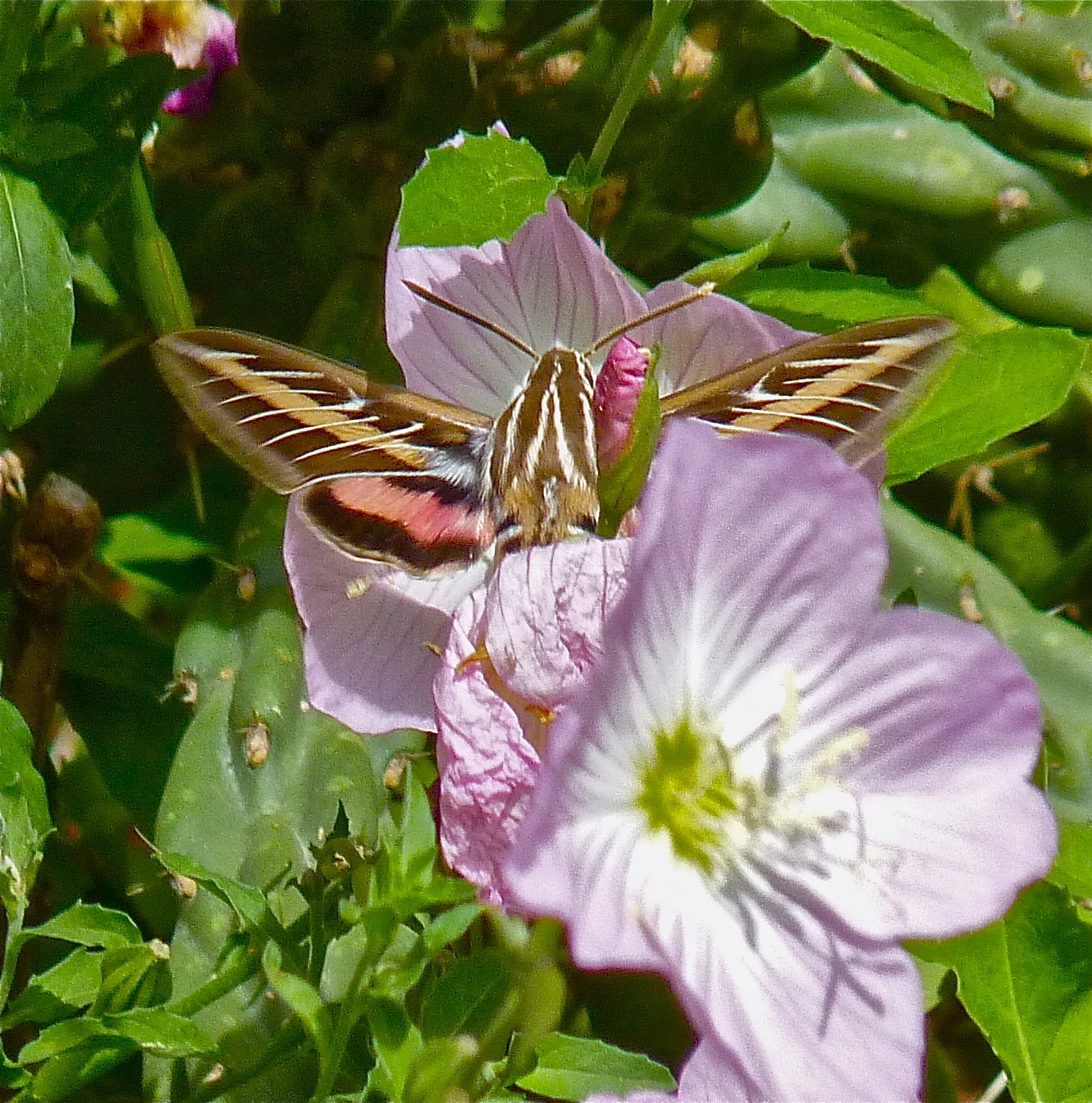
White Lined Sphinx  (Hyles lineata)


This next one had me stumped.  Hoverfly or Bee?  I looked at multiple sites and remained stymied until I reached out to the experts for identification help at the Bug Guide.  The answer came almost immediately (which somehow reinforced for me that the answerer, unlike me, really knew their bug stuff): Xylocarpa tabaniformis, aka the Carpenter Bee.
It was the eyes that had me thinking "hoverfly" but as is so often the case?  Wrong!

This guy was just barreling into the flowers.  He made up for with enthusiasm what he lacked in finesse.

We should all enjoy our work as much as this carpenter bee.
Carpenter bee makes perfect sense. We have all sorts of suitable habitat here.

Last but certainly not least?  Here's a local favorite I caught just as I was ready to call it a day and head back indoors.  Our resident hummingbird dropped in on the aloe bloom stalk as the flowers have just begun to open for visitors.

I have no idea what sort of hummingbird this is other than one that is adorably unthreatened by my proximity.  I have a strong suspicion we'll meet again.