I was finished. Turning over a new leaf. I firmly resolved, no more standing in the full sun, sucking in oak pollen, finger quivering with fatigue over the shutter button. No more focusing, refocusing, framing, reframing, all for nothing more than another series of fuzzy shots.
No. No no no!
I had fuzzy shots already. Tons of them. An entire photo library's worth of blurry near misses and photos that were close to good but not quite. I was calling it quits for the season. Done and done.
That's when it happened. We'd eaten lunch and there stood the Hub, gazing out the window, sipping iced tea and surveying his domain. That was when he said "Hey! Look! There's one of those pretty black butterflies out on your primroses!".
Dang it, I looked.

And there sure enough was, a Black Swallowtail. Thing is, they aren't usually around until May. So I began wondering if he might not be a Pipevine Swallowtail. Pipevines emerge earlier, routinely showing up in April, but between climate disruption and the typical butterfly reluctance to hold still for a definitive ID, it was hard to tell. I decided to stick with my first guess. Say hello to Papilio polyxenes, our first black swallowtail for 2014.
And you know, I couldn't let a milestone like that pass without taking just one photo, could I? Of course not!
Once I was out there with my camera, you already know in your heart what followed. Off I went, again, recklessly snapping away between sneezes, adding to my collection of not-so-hot photos of flittering fertilizers. Ready for more? Here's what I saw today:
Nessus Sphinx (Amphion floridensis)

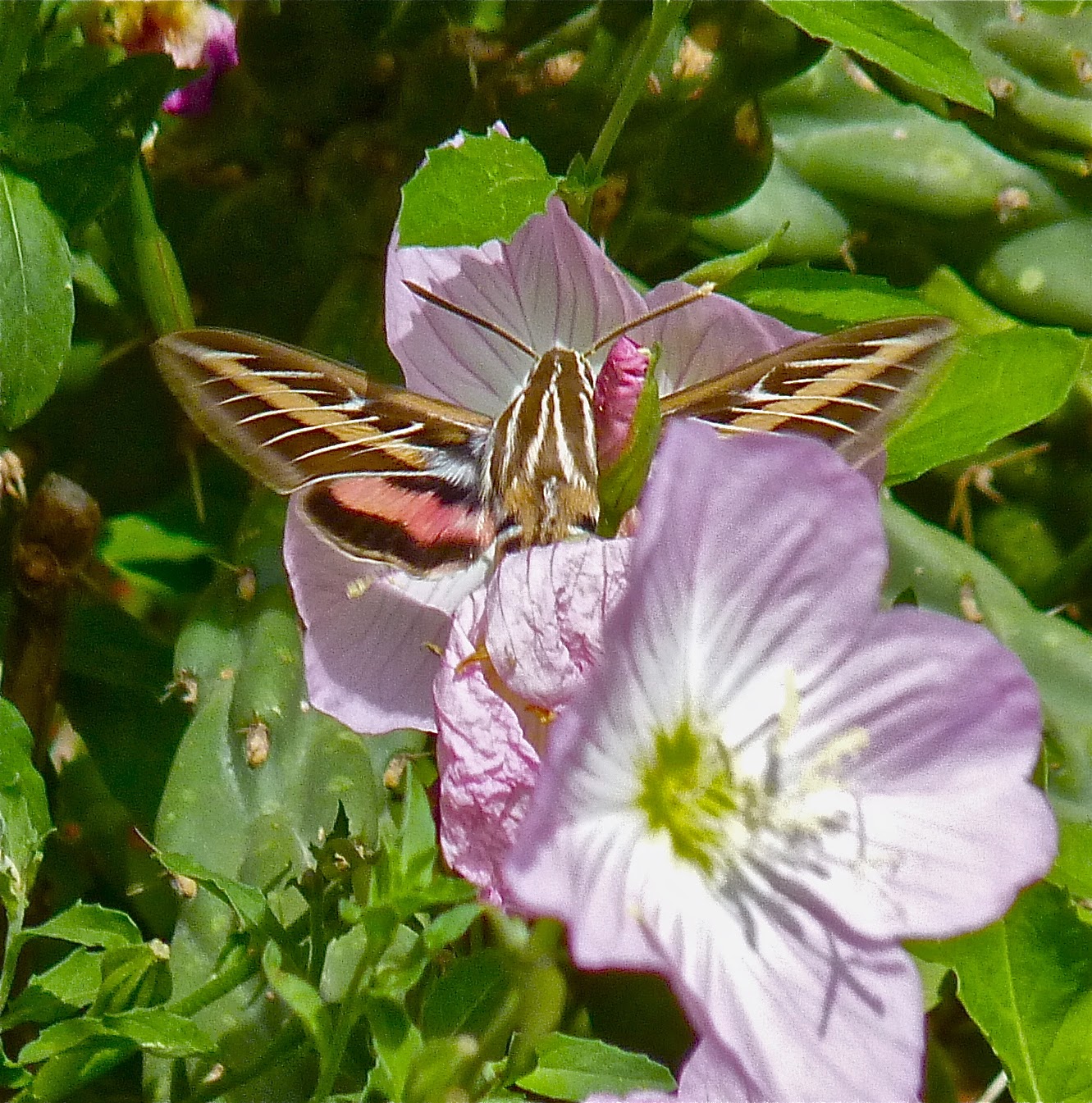
White Lined Sphinx (Hyles lineata)


This next one had me stumped. Hoverfly or Bee? I looked at multiple sites and remained stymied until I reached out to the experts for identification help at the Bug Guide. The answer came almost immediately (which somehow reinforced for me that the answerer, unlike me, really knew their bug stuff): Xylocarpa tabaniformis, aka the Carpenter Bee.
 |
| It was the eyes that had me thinking "hoverfly" but as is so often the case? Wrong! |
 |
| This guy was just barreling into the flowers. He made up for with enthusiasm what he lacked in finesse. |
 |
| We should all enjoy our work as much as this carpenter bee. |
Last but certainly not least? Here's a local favorite I caught just as I was ready to call it a day and head back indoors. Our resident hummingbird dropped in on the aloe bloom stalk as the flowers have just begun to open for visitors.


