Welcome!

Welcome to austinagrodolce … My family and I garden with more intention and enthusiasm than allocated budget or overall design plan. It shows. Wildlife populations don't seem to notice our lack of cohesive design, they just like the native plants here. It seems by growing local we've thrown out a welcome mat. Occasionally, we're surprised at who (and what) shows up.


Showing posts with label Sphinx Moth. Show all posts

Wednesday, April 23, 2014

The Wages of Moths (and butterflies)...

Every action in the natural world has a consequence.  When a gardener chooses plants specifically to "attract and host" butterflies and moths, here is what they are also asking for.

Caterpillars.  Brilliantly colored eating machines.  Mouths with legs (and in this case a bright yellow tail horn).
Sorry Charlie, but the All-You-Can-Eat Primrose Buffet is out in the back yard!
I can't tell you for certain which sphinx moth the caterpillar pictured above belongs to.  I'm pretty sure it is Hyles lineata, but we get regular visits from all sorts of sphinx moths so this guy, (gal?) could be a close relative.

As these things go, this particular caterpillar out by my front sidewalk was eating its way up to the ripening seed pods on one of a very few pink evening primrose plants growing where I'm trying to get them established.   I've got banks of them out back.

So I did what I could to gently dislodge it from the singleton plant it was eating bare and I moved it out back to the masses of Oenothera speciosa, where the damage will be negligible.

This may sound silly, but later I went out to the area where I'd moved the caterpillar.  I wanted to see if I could find it again and assure myself I'd made the transfer without causing undue harm.  The very first caterpillar I found (photo below) had different markings, so while I knew it wasn't the same one I'd moved, I at least felt reassured I'd picked an area other caterpillar mothers chose for their offspring.

The next candidate looked a lot more likely, but how to know for sure?

Truth be told, with my poor identification skills, there was no way to know for sure. After spotting a third caterpillar in the same bed however, I felt that no matter how my original passenger had fared, the survival of the species was not in any way jeopardized.


Once I started "seeing" these caterpillars did I become a little obsessed with hunting for more?  You already know the answer.


This one is headed back down the stem after a job well done.  You can see why they don't run much risk of attack from behind.

It turns out this patch of primroses is a veritable sphinx moth nursery.  Lullaby and good night!

Postscript:  I wrote and scheduled this post before I discovered another "eater" in the patch - an infestation of four lined leaf bugs.  If you didn't previously read about my decision to let one species feed while attempting to eradicate the other, check the post out here.

Tuesday, April 8, 2014

Photo Finish

Blame it on The Hub.  I know I do.

I was finished.  Turning over a new leaf.  I firmly resolved, no more standing in the full sun, sucking in oak pollen, finger quivering with fatigue over the shutter button.  No more focusing, refocusing, framing, reframing, all for nothing more than another series of fuzzy shots.

No.  No no no!

I had fuzzy shots already.  Tons of them.  An entire photo library's worth of blurry near misses and photos that were close to good but not quite.  I was calling it quits for the season.  Done and done.

That's when it happened.  We'd eaten lunch and there stood the Hub, gazing out the window, sipping iced tea and surveying his domain.  That was when he said "Hey! Look! There's one of those pretty black butterflies out on your primroses!".

Dang it, I looked.

And there sure enough was, a Black Swallowtail.  Thing is, they aren't usually around until May.  So I began wondering if he might not be a Pipevine Swallowtail. Pipevines emerge earlier, routinely showing up in April, but between climate disruption and the typical butterfly reluctance to hold still for a definitive ID, it was hard to tell.  I decided to stick with my first guess. Say hello to Papilio polyxenes, our first black swallowtail for 2014.  

And you know, I couldn't let a milestone like that pass without taking just one photo, could I?  Of course not!

Once I was out there with my camera, you already know in your heart what followed. Off I went, again, recklessly snapping away between sneezes, adding to my collection of not-so-hot photos of flittering fertilizers.  Ready for more? Here's what I saw today:

Nessus Sphinx (Amphion floridensis)

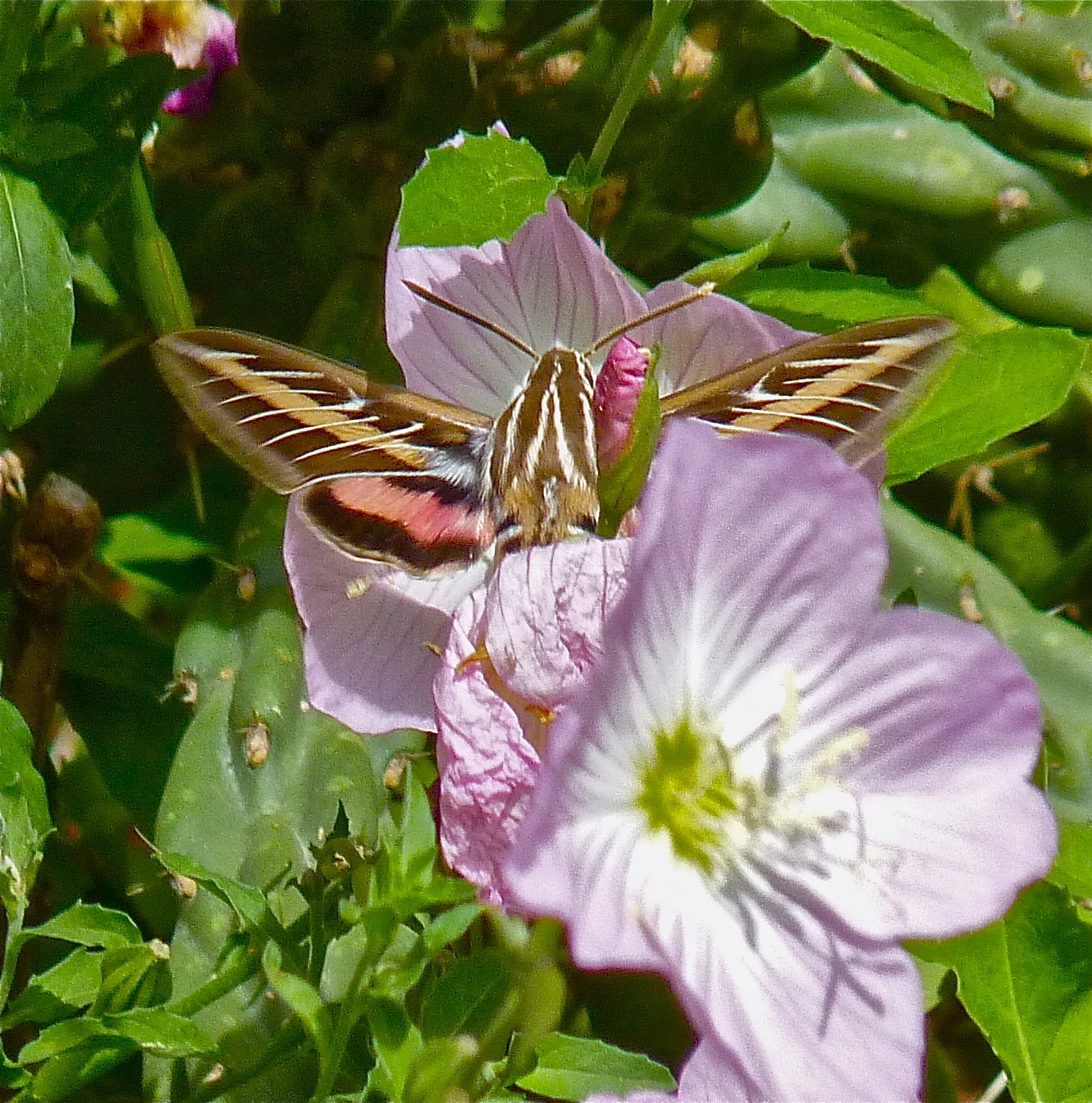
White Lined Sphinx  (Hyles lineata)


This next one had me stumped.  Hoverfly or Bee?  I looked at multiple sites and remained stymied until I reached out to the experts for identification help at the Bug Guide.  The answer came almost immediately (which somehow reinforced for me that the answerer, unlike me, really knew their bug stuff): Xylocarpa tabaniformis, aka the Carpenter Bee.
It was the eyes that had me thinking "hoverfly" but as is so often the case?  Wrong!

This guy was just barreling into the flowers.  He made up for with enthusiasm what he lacked in finesse.

We should all enjoy our work as much as this carpenter bee.
Carpenter bee makes perfect sense. We have all sorts of suitable habitat here.

Last but certainly not least?  Here's a local favorite I caught just as I was ready to call it a day and head back indoors.  Our resident hummingbird dropped in on the aloe bloom stalk as the flowers have just begun to open for visitors.

I have no idea what sort of hummingbird this is other than one that is adorably unthreatened by my proximity.  I have a strong suspicion we'll meet again.