Welcome!

Welcome to austinagrodolce … My family and I garden with more intention and enthusiasm than allocated budget or overall design plan. It shows. Wildlife populations don't seem to notice our lack of cohesive design, they just like the native plants here. It seems by growing local we've thrown out a welcome mat. Occasionally, we're surprised at who (and what) shows up.


Showing posts with label Perennials. Show all posts

Friday, May 30, 2014

A Preference for Perennials, and Two Potential Problems

That cottage garden look?  I love it.  I try to remind myself of that fact, and of how I've worked to recreate it in my own garden beds when I am sidetracked elsewhere by the visual impact of a massed single plant or the particularly effective use of negative space in a garden.

Cottage gardens are more old fashioned in appearance, and represent samplers of scattered plantings.  When in full bloom they are spectacular.  Naturally, I've complicated matters here by using lots of passalongs in concert with mostly native perennial plants.  As opposed to an abundance of seasonally coordinated annuals, a problem with perennials in the cottage garden (if you can call it that) is they rarely all bloom at the same time.

As a matter of fact, native perennials (and reseeding annuals) have evolved to fill a particular niche timewise as well as microclimate wise.  I suppose if they did all bloom together they'd be competing for pollinators and competition dodged is competition won when it comes to surviving in the Texas countryside.  I respect that.

Regardless, occasionally when I squint and angle the camera just so, I catch a shot that captures as close to a cottage garden look as my beds usually provide. No pull out all the stops, everything in bloom at one time showstoppers here, but more typically two things in bloom together.  Like so.


And so:


Like this:

Or this:

And here, my current favorite, which appeals to me more as a matter of focus than variety but who cares, because look:  Profusion, suggested.


And to wrap things up today, a glimpse not at flowers but at two foliage plants I love, which also represent where I can get into my own particular version of garden troubles.

This little beauty is Mimosa pudica, or sensitive plant.  The leaves fold up as a protective measure at the slightest touch.  The novelty of that aside, I love the way it looks and the fact it creeps along just above ground level, quietly providing a gorgeous green backdrop underneath other showier plants.

And how could this be a problem?  Mimosa pudica is categorized as an invasive plant.  By all rights I should be removing this everywhere I find it.  But I don't. I just can't make myself take it out. This plant might go haywire in other parts of the country but in my garden there are two or three smallish specimens that come back each spring.  They don't seem to be spreading though I kind of wish they would.  So I resolve to keep an eye on them and promise myself if they show any signs of taking over I'll yank them right out. 

And speaking of yanking something right out.  See this?  You might recognize this native,

by the characteristic white underside of the leaf.  Vitis mustangesis, or Mustang grape.  My mother-in-law made amazing mustang grape jelly every year and so I was excited when I first realized we had some growing in our own back yard.  But while hers was neatly trained and trellised on a split rail garden fence constructed by my father in law, ours is bird sown and grows like this:


Which would be fine if it stayed on the ground, but these vines grow at a phenomenal rate and would much rather ninja-kudzu themselves up into and over every shrub, bush and tree.  Honestly, as I stood in the midst of it to snap this photo I was alarmed at what felt like a tendril experimentally wrapping itself around my ankle.

I'm determined to find some way to tame these vines in our spaces as my in laws did, so eventually we might get as much a chance at the grapes as the birds and squirrels do.  Even if we never got a single jar of grape jam, I am a total sucker for these leaves.  I think they are gorgeous, green side up or white side under.  And while I dither about as to how best to tame them, season after season they get away from me and up into our trees, where they compete vigorously for sunlight and often shade out entire sections of the smaller trees.  When it comes to the question of who's in charge around here, I'm afraid the answer in this case is, The Vines!

Sunday, October 27, 2013

Ordinary Glories - Dependable Performers in a Central Texas Garden

Gardening is truly pleasurable in Texas in October.  The death star relents, rains reappear, cooler temperatures prevail. Garden and gardener alike are encouraged.

Every year in late Autumn I become mindful of certain especially tough beauties in my garden spaces.   Year in and year out they shrug off the ravages of heat and drought, taking advantage of Fall's kinder gentler nature for one last display of exuberant color.  I am a rapt audience.

Predictably enough, many of these knockouts in my gardens are native varieties. A few are adaptable near neighbors, but they all are stellar performers in my microclimates.  A few of them I bought, several of them I grew from hand gathered seed or passalong starts, and at least one of them was a gift, planted by wildlife.

Whatever their source they've each won their spot in my garden and in my admiration.
Marvel of Peru - Mirabilis, exact type unknown

I adore Four o'Clocks.  Many treat them as weeds, "trash plants" because they so often escape cultivation to flourish unattended.  I gathered the seed for the pinks alongside the tarmac in a local church parking lot a decade ago.  I found and collected seeds for a white blooming variety from plants I discovered the next year in an empty lot before it was bulldozed for building.  

These provide season long color in several of my shaded spaces. They produce an enormous tap root that takes them sailing through harsh weather and though they can be devastated by insects, the deer don't bother them.  Knowing they'll bounce back I feel free to cut them back whenever they get straggly or overly tall.  To play it safe I collect seed of each color in the Autumn, so I'll have replacement options as needed.
Ham and Eggs Lantana
I've read criticism that Lantana is over used in our area.  I beg to differ.  Any xeric plant that supports wildlife, blooms nearly year round and produces such a variety of colors on a single specimen will always have a place here.  This particular plant arrived via birds (but works where it is - the birds often have a good eye for planting) so I'm taking a stab at identification based upon the bloom colors.  I don't care what it is called, it is thriving where it is and looking good doing it.  
Tropical Sage
Salvia Coccinea is another freely spreading plant and as it appears on natives lists I feel permission has been granted to both abuse it and let it run amok in my spaces.  I prune it whenever I want, transplant it during all the "wrong" times of year, and trust it will come back from the roots as well as freely reseed should a cold winter actually materialize.  I've read complaints these don't respond well to heat and drought but mine are in shade much of the day and if they get stressed looking I cut them back to the ground and they've come back vigorously year after year.  The pollinators and hummingbirds love these and so do I.
Giant Cosmos dominates the back of the garden beds
This Giant Cosmos is a throwback.  I never would have known what it was without this post from fellow local gardener and artist Bob Pool at Draco where he wrote about getting the seed from a local plant sale vendor.  I'm not sure how it arrived in my beds, I don't believe you can buy seed for it (packets advertising "giant" refer to large blooms) but arrive it has.  Now I recognize the giants when they start out, I allow it to reseed freely and simply remove the plants that crop up in spaces I don't want. 


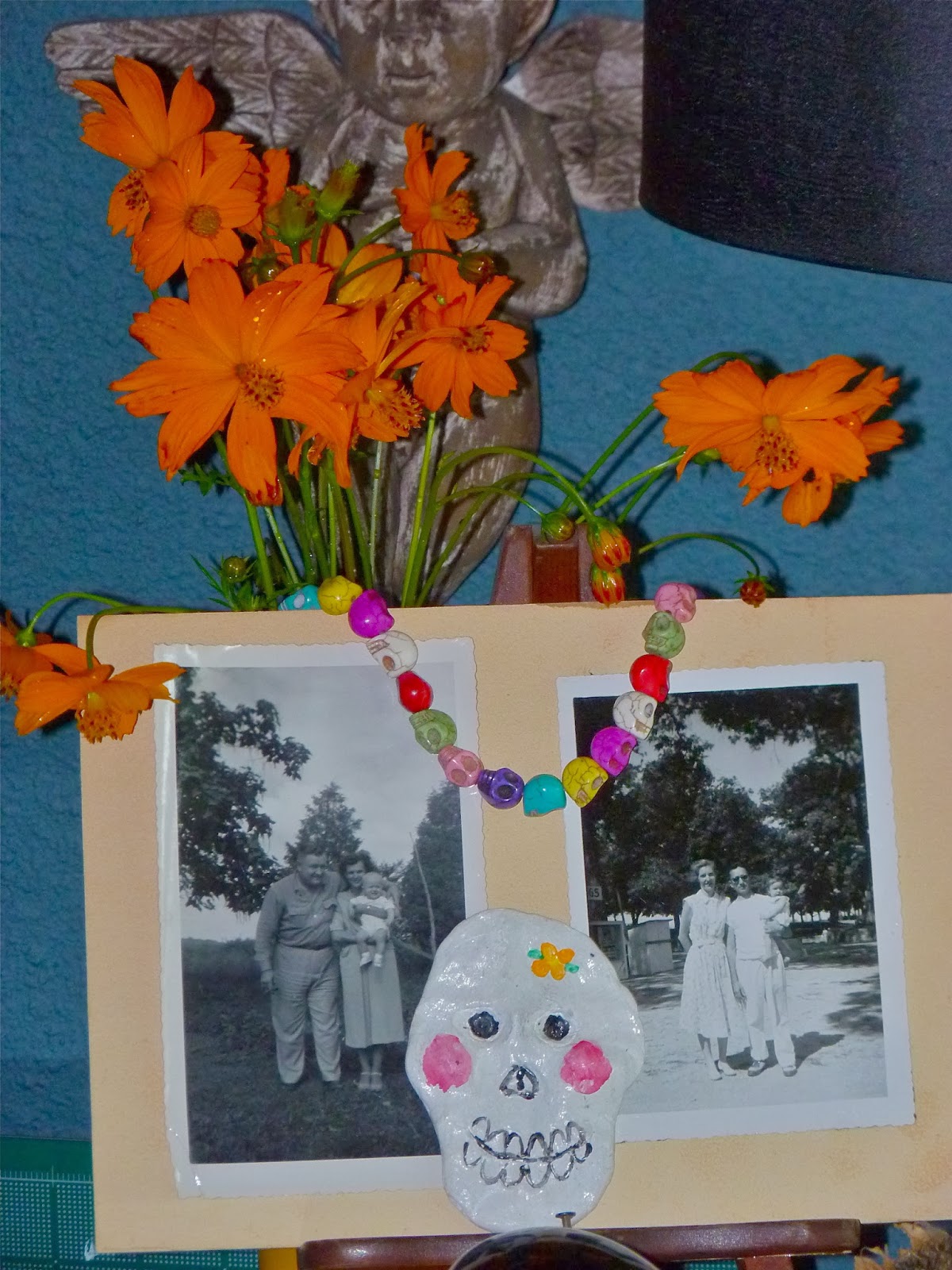
The "Giant" appears late in spring and grows 5-6 feet tall before setting bloom.  It often needs staking after a heavy Fall rain. Once they do appear the prolific brilliant orange flowers remind me a bit of tall marigolds. As such they have become part of our Dia de los Muertos altar ofrendas. 

Mexican Tarragon
While I have often failed miserably in my attempts to grow tomatoes,  I have had luck growing herbs in my garden.  I thoroughly enjoy having fresh herbs to cut for cooking and while the French Tarragon won't take the Texas heat, its southern cousin, Tagetes lucida loves it.  I use the leaves freely for cooking all year until they are killed by the first freeze.  The blooms are a visual bonus from a plant I've been raiding for dinners for months.  
Chile Tepin
Also called bird's eye peppers, these fiery little chiles grow on a fair sized bush alongside a path where they tolerate being brushed aside without complaint.  They are thought to perhaps be the oldest form of Capsicum annuum.  I just know they'e beautiful and make a great hot vinegar.  I've got a few bird planted volunteers going now and look forward to more.  With their tiny white flowers appearing amongst green and ripened red peppers throughout, they'd make a lovely Christmas wrapping paper pattern don't you think?
Wild Morning Glory aka Purple Bindweed
These wild morning glory vines definitely fall into the pest category (Ipomoea cordatotriloba).  They are essentially Bermuda Grass with blooms, spreading by prolific reseeding and roots that go deep enough to never be dug completely out. We kept them in one small contained area because just look at those flowers!   And all without a drop of supplemental water.  I am a total sucker for a morning glory bloom even if it means I'm digging starts out of our paths and other beds all summer long.  
Grandpa Otts' Morning Glory
These lovelies are heirlooms - the legitimate, acceptable version of the Morning Glory (though not native to our area). After a couple of years the Grandpa Ott vines reliably reseed themselves but I put out fresh seed annually to assure placement. The semi-shade in the area means the vines don't cover with blooms but also assures it stays manageable.  A couple of times a year I gently unwind tendrils from the nearby Mountain Laurel (a partner in purple blooms) and that's it.  
Jewels of Opar
The Jewels of Opar were an impulse buy, prompted by their whimsical name, from the sale table at a garden center that sells mostly natives.  Talinum paniculatum are native to much of the South and Southwest (a close relative to portulaca) and spread freely by the berries carrying seed that appear in tandem with the tiny pink floral precursors.  These multicolored "jewels" originally caught my eye, along with the pop of chartreuse colored leaves at the base.  

I began with one four inch pot and now have multiple large clusters of them, having transplanted seedlings into several beds where they flourish in hours of direct sun, tolerate hours of deep shade, and generally laugh off everything but deer browse and hard freezes.  When we have a hard winter they die off to the ground only to reappear from the roots once the weather warms.  When we have a hard summer (and when is that not the case?) the leaves wilt occasionally but once out of the direct sun they perk right back up and carry on.   
Spineless prickly pear
Passalongs.  In my neighborhood, after pruning, gardeners will leave piles of pads of these native "spineless" cacti curbside with a sign indicating they are free to be taken.  Opuntia ellisiana don't have long needles, but they do have little clusters of irritating tiny spines that are a reminder to keep from getting too careless.  

Prickly pear don't require special treatment - they don't even require planting per se. Simply place them where they are wanted and if left undisturbed long enough they'll root where they meet the earth.  When they get too tall or wide the pads easily snap off to maintain the desired profile.  
Rivina humilis
Last for today, but certainly not least, is the Pidgeonberry plant.  Rivina humilis is not a particularly drought tolerant native, but with a little assistance will establish itself on a shady hillside and provide flowers for pollinators simultaneously with fruit for birds.  This one is competing capably amongst the tropical sage plants.  I cut the sage back severely in late September allowing the pidgeonberry to rise above during its season of glory.  With a supplemental water source I've no doubt it would be appearing en masse, but our recurrent water shortages preclude such pampering.  As such I enjoy the slower spread even more for the hardiness it truly represents.

There you have it.  No elite group at all but rather a more working-class collection of perennial performers in our demanding Central Texas climate. Some are old fashioned, several are held in current disdain, but left to their own devices these are all plants that require little to no assistance to thrive, much less survive.   As I get older I've discovered I must carefully steward my available energies and heat tolerance for work in our garden spaces.  I find I am more and more grateful for these plants that once introduced, will simply take care of themselves.