Welcome!

Welcome to austinagrodolce … My family and I garden with more intention and enthusiasm than allocated budget or overall design plan. It shows. Wildlife populations don't seem to notice our lack of cohesive design, they just like the native plants here. It seems by growing local we've thrown out a welcome mat. Occasionally, we're surprised at who (and what) shows up.


Showing posts with label Fall Color. Show all posts

Wednesday, September 16, 2015

Anticipating Autumn

Though the calendar reads "September" and we've enjoyed a welcome sampler of rainy spells interspersed with some cooler mornings, it is not yet reliably Autumn per se in the Austin area.  We are stuck for a few more weeks in what is more accurately described as protracted Summer.

Early signs of Autumn abound, but those have been well described and beautifully displayed in posts on multiple other (excellent) local garden blogs.

Schoolhouse and pink rain lilies popping up cheerfully in response to long awaited September rains?  Yup. Those have already been blogged about. Several times.
Turk's cap in bloom? Posted elsewhere. Beautyberry bushes and Pidgeonberry eponymously decked out?  Duly noted and reported on other sites.
Inland Sea Oat seed heads shown to their best backlit advantage?  Uh huh, saw that already. Datura blooms?  Photographed in daylight as well as in the moon's golden glow.  Garlic chives?  With and without bees. Lindheimer's senna? Various salvias and Leadwort plumbago?  All shown in flower and exquisitely documented elsewhere.

The usual suspects have definitely already gotten their fair share of the attention.

I wanted to post, but didn't see where I'd gain traction posting more (and not necessarily better) photographs of the plants already listed alongside various lame versions of "what she said".  My frustration mounted. Had I missed Autumn's boat? Was this territory too familiar, too well trod?  Had those other (better organized) bloggers covered alpha all the way to omega?  Couldn't I find one single as-yet unsung wonder left out there waiting its turn in the spotlight?

I groused, I deleted, I muttered. I was about to give up when, scrolling through my most recent photos, I saw both the plants and the light. There were a few also-rans out there not yet covered. Team captains had chosen their favorites first, but there were definitely other players remaining. So here they are, in no particular order, "latter but not least" additions, my own nominees to the lineup of late summer/early autumn stars designate for Central Texas in September.

To kick things off, a native, Texas Kidneywood (Eysenhardtia texana), which is currently flaunting a scent so pronounced it demands attention.
And attention it gets.  The flower spikes open a few at a time, advancing in numbers day by day until the entire tree becomes a fully loaded, heavily scented pollinator magnet.  Gray Hairstreak (Strymon melinus) butterflies favor it, nectaring alongside honeybees,
all sorts of native bees, bee mimics,
and even wasps.  Like this blue-winged Scolia dubia. They all spend hours darting in and out amongst the flowers, drinking their fill.
Scolia dubia- female blue winged digger wasp.
All that traffic drew even more attention, including that of the local anole population (Anolis carolinensis).
Using their coloration disguise to full advantage, they are lurking in proximity to branch ends in numbers, hoping to snap up a delicious meal all their own from amongst the winged visitors.
In fact, anoles can be seen everywhere these days including this little lip smacker perched on a flower spike of H. Duelberg salvia.
The delicate pink blossoms of Coral Vine, (Antigonon leptopus) are visited all day by pollinators of every stripe....
followed by even more anoles.  Dinner's on!
Non-native but well adapted and widely appreciated south of I-10, Firebush (Hamelia patens) comes back from the roots and kicks into high gear during our very hottest weather.  As the arrival of summer's heat was delayed, it got off to a slow start this year.  Unlike many other plants that went leggy with a vengeance, this seasonal beauty has only grown to half its usual spread and height.
I don't mind a bit.  I like it small or tall, and look forward to when glowing embers at branch ends are lighting up the bed it graces.  Hummingbirds love this plant though you'll have to take my word for that.  The delayed timing this year must be wreaking havoc with their usual feeding habits.
Beleaguered but persistent Fall Obedient plant is finally attempting blooms. Physotegia virginiana likes things wet, but the weeks of heat with no rain that followed spring's bounty took their toll.  This is a tough native however, and good year or bad, I know these will always come back for more.
This little patch of Virginia dayflower, (Commelina virginica) is blooming for a few hours daily, but it is new for me in this spot and I haven't watched it long enough to know if the current show will be reliable year to year.
Like the Firebush, October showstopper Giant Cosmos (Cosmos sulphureous), while only half its usual six foot size this year, is budding out.
Just beginning to appear, Goldeneye (Viguiera dentata) flower heads are small but expanding daily.
There you have it -  my add-ons to the pantheon of reliable late summer to early autumn bloomers in the central Texas area.  Taken in total they provide heat weary Texans with assurance weather is on the way better aligned with the calendar's insistence.

This year has certainly been one for the record books.  What about your garden spaces?  Seeing any surprises in your late summer garden after all our weird weather this year?  I'm sure there are wonderful plants I've overlooked or simply don't enjoy success with here. Lycoris radiata have been reported in bloom a few miles from me, but mine have yet to show.  Are you noticing other emerging changes?  Feel free to list them in the comments section.

Let's keep building the list!


Tuesday, September 9, 2014

Fall Color

Native Texans will automatically sense I'm joking around by invoking the term "Fall Color".  According to our State's many gleeful detractors, we not only lack authentic autumn weather here in Texas, but what with our prevalent cedar and live oak trees, we most certainly do not have anything that passes for Fall Color.

Up to a point, our detractors are correct.  Through October, much less September, our weather rarely calls for donning a sweater, unless like me, you're a bit sensitive to the chill provided by air conditioners.   And with the possible exception of a couple of the less common trees to our area, there are not a lot of leaves changing colors to signal winter is on the way.

Yet I maintain we do have our own set of color signifiers.  They just aren't going to be apparent if you are looking up.  In my garden spaces, rather than foliage displays, Fall Color is more about the appearance of certain blossoms that wait until summer's heat has abated.  Around here, these flowers are just as reliable a sign of the change in seasons as any flashy, look-my-leaves-are-dying tree.

One sure pop of color hitting its stride right now?  Hamelia patens, or Mexican firebush.  While this plant is native to Florida, it is a well adapted non-native, designated a Texas Superstar by Texas A&M.  Native or not, it does a great job supporting native pollinators and hummingbirds with its tubular blossoms.  A bit cold sensitive, mine has reliably come back from the roots after the harshest winter weather.  The protracted cold we experienced last year put a bit of a delay on bloom initiation, but there was no stopping this beauty.
Next up? Scarlet Sage, or Salvia coccinea.  This self-seeder resists deer and tolerates shady hillsides with poor soil, making it ideal for lining the drive up to our house.
I keep these trimmed down to prevent legginess but that is all the care they require.  Once the summer heat fades a bit these tough little plants reward us and the hummingbirds with weeks of blooms.  Fighting against my childhood indoctrination that you cannot mix red and pink, I've got both colors going out front.
Occasionally I gather the seed pods off a spire and sprinkle them into some new spot.  Maybe the birds are doing the same?  I don't care who is responsible, I'm just happy to have these pretties popping up in all sorts of relatively inhospitable places.
Perhaps you noted that blurry bit of yellow in the background of the photo above?  Let's pull that into focus next, for it deserves a view all its own.  I first noticed Lindheimer's senna on a trip The Hub and I made out to the Lake Buchanan area years ago.  It was an El NiƱo winter, and the senna bushes were blooming away in January.  I loved their leaves as much as their blooms, and was determined to introduce some into our spaces.
For a gardener on a tight budget, Senna is a very wise choice.  These tough natives produce readily collectible seed pods with a fairly sturdy germination rate.  You might need to buy one senna plant, but if you are patient and want more? You'll never need to buy a second one.

Speaking of easily propagated, no fall color lineup would be complete without making mention of Fall Obedient Plant, Physostegia virginiana.  
A distant relative of mint (those squared stems are a dead giveaway), this plant is predictably willing to spread past its point of origin, earning it the label of "potentially aggressive".  While this beauty does love to multiply, it is easy to pull out, and though it reportedly gets fairly tall in the moist shady areas it prefers, in my much drier sunnier spaces it maintains a more modest height.  I've read this is highly deer resistant, though I haven't put that to the test here.  Yet.  Hummingbirds love these freckled purple flowers and so do I.

Each year I cheerfully take the plants that have strayed past the bed border and transplant them into some new corner that could use a little pop of purple in September.  As it turns out, there are lots of those corners here and so far, the obedient plants have adapted to everything but the hottest driest spaces.

To continue our parade of Fall Color in Texas, I'd like to salute a small native tree,  the Texas kidneywood (Eysenhardtia texana).  It might not sport brightly colored leaves, but its white bloom spires are every bit as welcome.
Mildly fragrant, these blooms are swarmed by pollinators for hours every day. Withstanding a blast of afternoon sun all summer long, this well mannered little tree blooms intermittently from May well through October.  I admire its delicate foliage in between flowerings, but it is hard not to be smitten with kidneywood's sweet white blooms.

Unless it is purple berries you'd prefer?  Then you'll appreciate the closer for my Fall Color roundup, the Beautyberry (Callicarpa americana).  The name says it all.  See for yourself.
Deer love the leaves, birds love the berries, I love the look. Color? Beautyberry has your color right here.  If the spectacular magenta berries taste as delicious as they look, then it is no wonder the birds and squirrels fight over these. Preferring a bit of shade, these edge habitat understory natives bring their own light to the party.

OK East Coasters.  I've had my fun.  It is September again and you will have your annual run of glory days to boast of striking fall color. Your reputation is well deserved as far as it goes.  But please, don't ever try to convince me we don't have color in Texas in the Fall.  It might not be the leaves on our trees capturing the spotlight each autumn, but when it comes to color in the landscape?  We've got gracious plenty.

Sunday, October 27, 2013

Ordinary Glories - Dependable Performers in a Central Texas Garden

Gardening is truly pleasurable in Texas in October.  The death star relents, rains reappear, cooler temperatures prevail. Garden and gardener alike are encouraged.

Every year in late Autumn I become mindful of certain especially tough beauties in my garden spaces.   Year in and year out they shrug off the ravages of heat and drought, taking advantage of Fall's kinder gentler nature for one last display of exuberant color.  I am a rapt audience.

Predictably enough, many of these knockouts in my gardens are native varieties. A few are adaptable near neighbors, but they all are stellar performers in my microclimates.  A few of them I bought, several of them I grew from hand gathered seed or passalong starts, and at least one of them was a gift, planted by wildlife.

Whatever their source they've each won their spot in my garden and in my admiration.
Marvel of Peru - Mirabilis, exact type unknown

I adore Four o'Clocks.  Many treat them as weeds, "trash plants" because they so often escape cultivation to flourish unattended.  I gathered the seed for the pinks alongside the tarmac in a local church parking lot a decade ago.  I found and collected seeds for a white blooming variety from plants I discovered the next year in an empty lot before it was bulldozed for building.  

These provide season long color in several of my shaded spaces. They produce an enormous tap root that takes them sailing through harsh weather and though they can be devastated by insects, the deer don't bother them.  Knowing they'll bounce back I feel free to cut them back whenever they get straggly or overly tall.  To play it safe I collect seed of each color in the Autumn, so I'll have replacement options as needed.
Ham and Eggs Lantana
I've read criticism that Lantana is over used in our area.  I beg to differ.  Any xeric plant that supports wildlife, blooms nearly year round and produces such a variety of colors on a single specimen will always have a place here.  This particular plant arrived via birds (but works where it is - the birds often have a good eye for planting) so I'm taking a stab at identification based upon the bloom colors.  I don't care what it is called, it is thriving where it is and looking good doing it.  
Tropical Sage
Salvia Coccinea is another freely spreading plant and as it appears on natives lists I feel permission has been granted to both abuse it and let it run amok in my spaces.  I prune it whenever I want, transplant it during all the "wrong" times of year, and trust it will come back from the roots as well as freely reseed should a cold winter actually materialize.  I've read complaints these don't respond well to heat and drought but mine are in shade much of the day and if they get stressed looking I cut them back to the ground and they've come back vigorously year after year.  The pollinators and hummingbirds love these and so do I.
Giant Cosmos dominates the back of the garden beds
This Giant Cosmos is a throwback.  I never would have known what it was without this post from fellow local gardener and artist Bob Pool at Draco where he wrote about getting the seed from a local plant sale vendor.  I'm not sure how it arrived in my beds, I don't believe you can buy seed for it (packets advertising "giant" refer to large blooms) but arrive it has.  Now I recognize the giants when they start out, I allow it to reseed freely and simply remove the plants that crop up in spaces I don't want. 


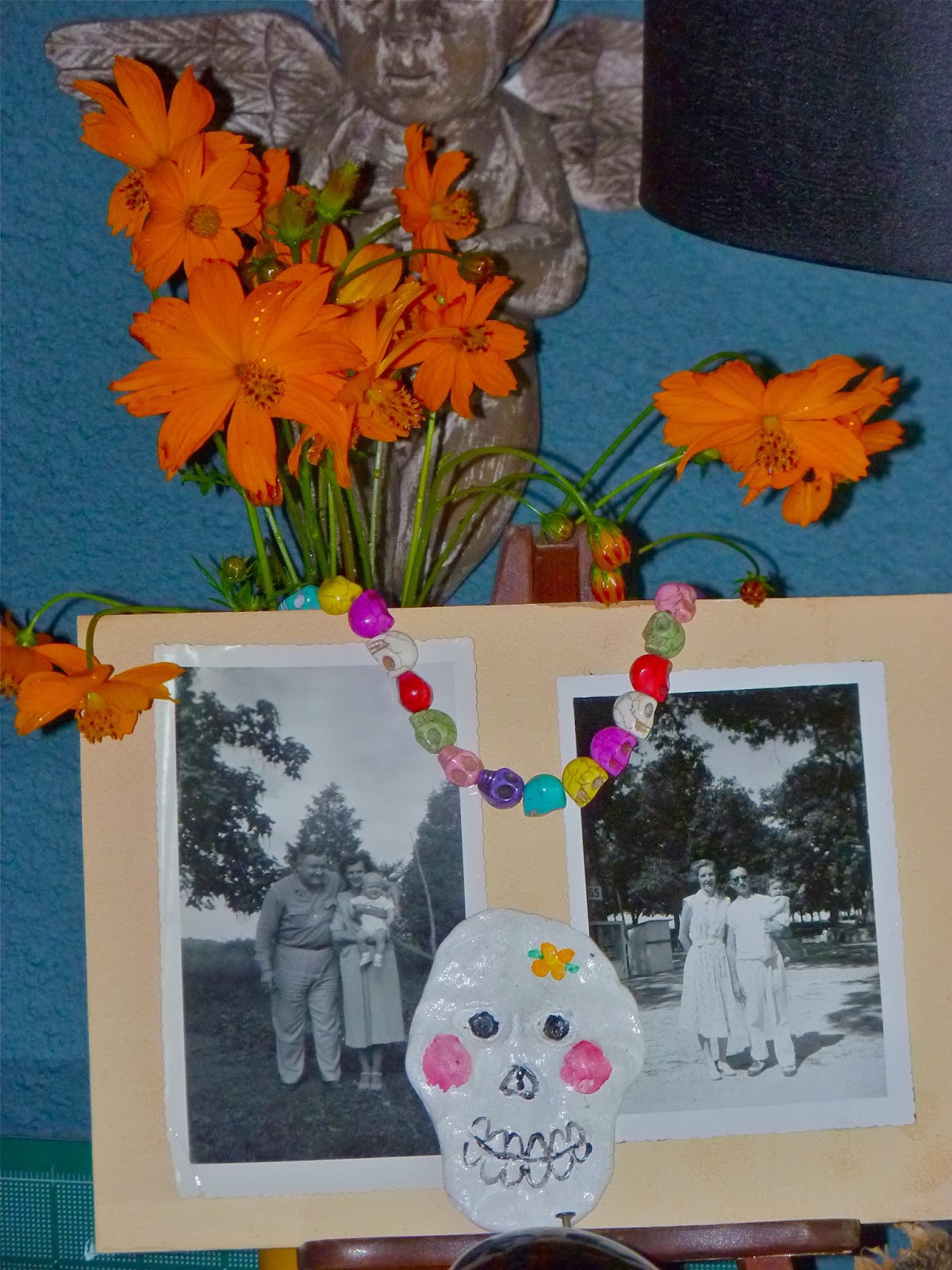
The "Giant" appears late in spring and grows 5-6 feet tall before setting bloom.  It often needs staking after a heavy Fall rain. Once they do appear the prolific brilliant orange flowers remind me a bit of tall marigolds. As such they have become part of our Dia de los Muertos altar ofrendas. 

Mexican Tarragon
While I have often failed miserably in my attempts to grow tomatoes,  I have had luck growing herbs in my garden.  I thoroughly enjoy having fresh herbs to cut for cooking and while the French Tarragon won't take the Texas heat, its southern cousin, Tagetes lucida loves it.  I use the leaves freely for cooking all year until they are killed by the first freeze.  The blooms are a visual bonus from a plant I've been raiding for dinners for months.  
Chile Tepin
Also called bird's eye peppers, these fiery little chiles grow on a fair sized bush alongside a path where they tolerate being brushed aside without complaint.  They are thought to perhaps be the oldest form of Capsicum annuum.  I just know they'e beautiful and make a great hot vinegar.  I've got a few bird planted volunteers going now and look forward to more.  With their tiny white flowers appearing amongst green and ripened red peppers throughout, they'd make a lovely Christmas wrapping paper pattern don't you think?
Wild Morning Glory aka Purple Bindweed
These wild morning glory vines definitely fall into the pest category (Ipomoea cordatotriloba).  They are essentially Bermuda Grass with blooms, spreading by prolific reseeding and roots that go deep enough to never be dug completely out. We kept them in one small contained area because just look at those flowers!   And all without a drop of supplemental water.  I am a total sucker for a morning glory bloom even if it means I'm digging starts out of our paths and other beds all summer long.  
Grandpa Otts' Morning Glory
These lovelies are heirlooms - the legitimate, acceptable version of the Morning Glory (though not native to our area). After a couple of years the Grandpa Ott vines reliably reseed themselves but I put out fresh seed annually to assure placement. The semi-shade in the area means the vines don't cover with blooms but also assures it stays manageable.  A couple of times a year I gently unwind tendrils from the nearby Mountain Laurel (a partner in purple blooms) and that's it.  
Jewels of Opar
The Jewels of Opar were an impulse buy, prompted by their whimsical name, from the sale table at a garden center that sells mostly natives.  Talinum paniculatum are native to much of the South and Southwest (a close relative to portulaca) and spread freely by the berries carrying seed that appear in tandem with the tiny pink floral precursors.  These multicolored "jewels" originally caught my eye, along with the pop of chartreuse colored leaves at the base.  

I began with one four inch pot and now have multiple large clusters of them, having transplanted seedlings into several beds where they flourish in hours of direct sun, tolerate hours of deep shade, and generally laugh off everything but deer browse and hard freezes.  When we have a hard winter they die off to the ground only to reappear from the roots once the weather warms.  When we have a hard summer (and when is that not the case?) the leaves wilt occasionally but once out of the direct sun they perk right back up and carry on.   
Spineless prickly pear
Passalongs.  In my neighborhood, after pruning, gardeners will leave piles of pads of these native "spineless" cacti curbside with a sign indicating they are free to be taken.  Opuntia ellisiana don't have long needles, but they do have little clusters of irritating tiny spines that are a reminder to keep from getting too careless.  

Prickly pear don't require special treatment - they don't even require planting per se. Simply place them where they are wanted and if left undisturbed long enough they'll root where they meet the earth.  When they get too tall or wide the pads easily snap off to maintain the desired profile.  
Rivina humilis
Last for today, but certainly not least, is the Pidgeonberry plant.  Rivina humilis is not a particularly drought tolerant native, but with a little assistance will establish itself on a shady hillside and provide flowers for pollinators simultaneously with fruit for birds.  This one is competing capably amongst the tropical sage plants.  I cut the sage back severely in late September allowing the pidgeonberry to rise above during its season of glory.  With a supplemental water source I've no doubt it would be appearing en masse, but our recurrent water shortages preclude such pampering.  As such I enjoy the slower spread even more for the hardiness it truly represents.

There you have it.  No elite group at all but rather a more working-class collection of perennial performers in our demanding Central Texas climate. Some are old fashioned, several are held in current disdain, but left to their own devices these are all plants that require little to no assistance to thrive, much less survive.   As I get older I've discovered I must carefully steward my available energies and heat tolerance for work in our garden spaces.  I find I am more and more grateful for these plants that once introduced, will simply take care of themselves.

Sunday, September 23, 2012

Happy Second Day of Autumn!

Sure, sure.  Most people would indeed be wishing you a happy first day of Autumn.

Do we really want to waste time quibbling about whether it is more important to celebrate a first than a second day? All while cooler morning air evaporates into another stark reminder that Autumn in Central Texas is more a suggestion than seasonal change?

I thought not.

There will certainly be no shortage of internet foliage shots available if borrowed imagery is your deal.

And yet?  I find the color we get around these parts, the show that begins after a couple of welcomed rains in combination with cooled overnight air, though mostly of the Last Gasp Flowering variety? It is soothing and inspiring in its own way.

So if it is colored leaves you desire, please feel free to look elsewhere.  To follow is everything I've got to ease your summer weary eyes...


I listened, straining.
Shook my head
and listened once more.

It was then I heard her.

"I too, 
am Autumn's offering"
the Pomegranate was whispering
in my garden.

"Do I not embrace cooler mornings, 
eased afternoons,
respite from summer's braggadocio of heat?"

"I flower and fruit,
offering tribute to 
all that is,
has been,
or can be."

"You callously 
worship leaves
as they lose their life stream."

I heard her sigh.

"But I too,
I too am Autumn."