This caterpillar was fairly easy - rather less camouflaged next to a pile of pollen on my windshield than when it was when more intentionally located up above on the overhanging live oak branches.
The Catocala ilia caterpillar, recognized for its lichen mimicry, favors flowering oaks (Quercus) among others. The adult moth is sometimes called a Beloved underwing, or Wife underwing. As long as you don't over think things, that's kind of romantic, yeah?

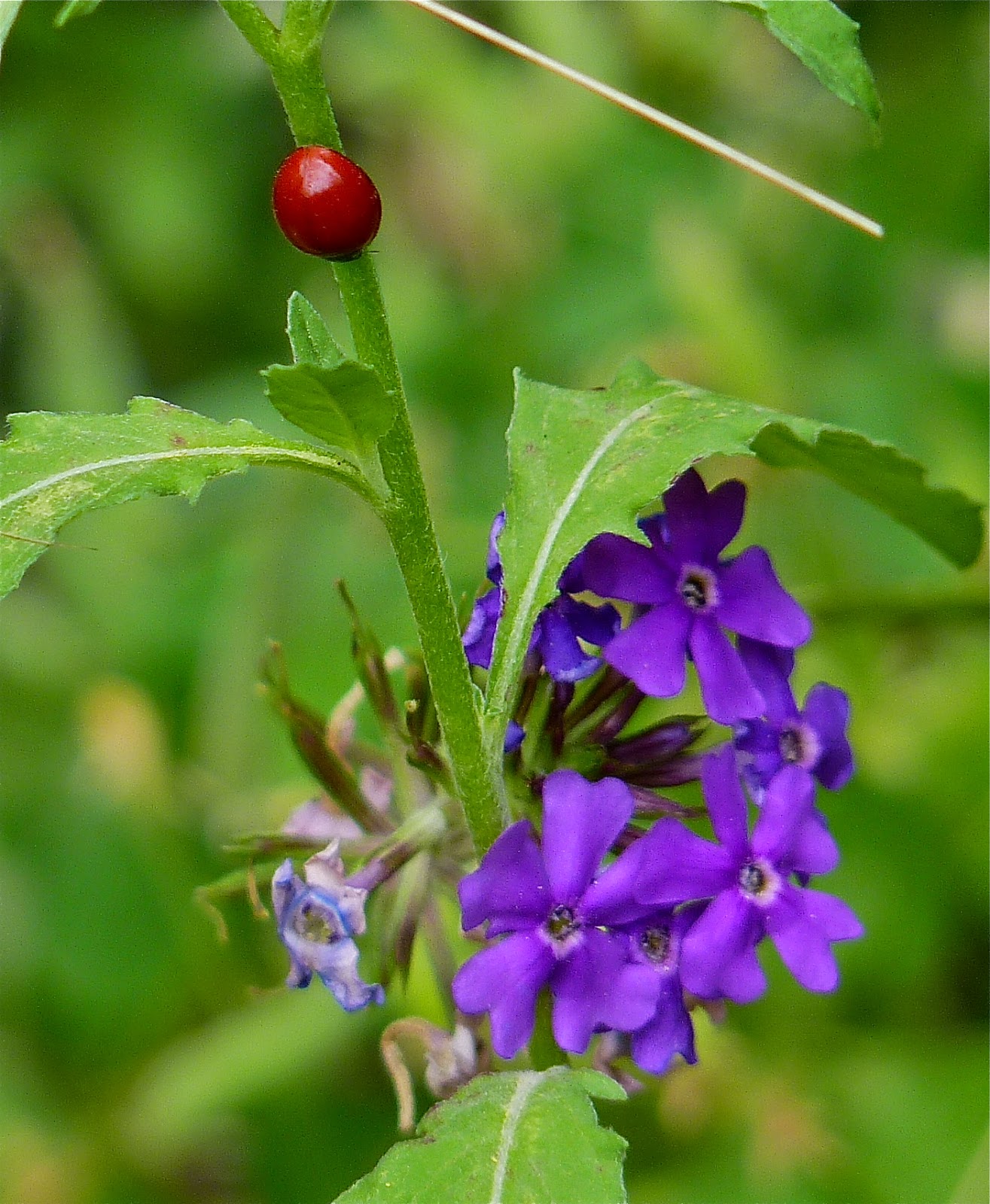

It's tricky, keeping track of visitors. There are days I yearn for tiny name tags. As I learn to look for one characteristic, it seems I discover soon thereafter about other markings needed to identify with any real specificity. At any rate, none of the beetles I've found this year so far are the native Nine-spotted Ladybugs researchers are currently monitoring. Introduced or not, they are all welcome here. I'm happy for any variety.
Less desirable perhaps but still striking in appearance, this leaf-footed bug, a member of some branch of the Coreidae family.


Checking back a third time I was relieved the leaf-foot party of two had moved on. If I found them gathering in large numbers I'd be tempted to intervene, and I'm trying to keep that to the bare minimum, seeing if systems won't balance out long run when left to their own devices.
Recently from across the yard I noted motion by a far corner of our lot. I took a quick shot without really being able to see what I was trying to capture, figuring by the time I reached close-up range the kerfluffle causer would have left the scene. Which it did, leaving me hanging until I could download the photo and get a closer look.
Cropping and enlarging revealed the culprit, a Texas spiny lizard (Sceloporus olivaceus). Only occasionally do I catch a glimpse of these and even more rarely do I get a photo as they are fleet of foot and shy by nature. Compared to the camera friendly anole, spiny lizards are the Greta Garbos of the garden.

Some butterflies are easy to identify. The Papilo glaucus, or Eastern tiger swallowtail, is comparatively huge, just difficult (for me) to capture in a photograph as this one was staying high in the tree tops.

More ovipositing, this time by a Eight Spotted Forester Moth. This one, like most of the ones I've observed in our yard, was favoring Virginia creeper as a host plant, but seemed fine with laying the occasional egg on pink evening primrose stems growing in and amongst the creeper. Creeper adjacent must be good enough.


I do take some small comfort in not being alone in my identification woes, at least when it comes to Skippers. From the internet:
"Many species of skippers look frustratingly alike. For example, some species in the generaAmblyscirtes, Erynnis (duskywings) and Hesperia (branded skippers) cannot currently be distinguished in the field even by experts. The only reliable method of telling them apart involves dissection and microscopic examination of the genitalia, which have characteristic structures that prevent mating except between conspecifics.[1]"
Um, OK. I think I left my dissection kit in my other pants, along with my butterfly genitalia microscope. Ahem! Skipper it is, then, unspecified.
Speaking of unspecified, this tiny jewel of a beetle resisted all my attempts to find its niche in the realm of identified visitors. I think of it as The Little Green Gorgeous and only hope it is not the first of some horde yet to come, or other well known (to everyone but me) pest I ought to have eradicated on sight.

Another set of even tinier feet trudging across the path belonged to this leaf litter ant, perhaps Ponera pennsylvanica?

And now, to close... What, you didn't think I'd end a post about fauna in the flora without the obligatory anole portrait did you?

I realize I gripe a lot. I'm really experiencing more fascination than frustration. So far, paying closer attention to the full variety of beauty (and occasional beast) has been its own reward. I hope you've enjoyed taking a closer look, too. Happy trails!

